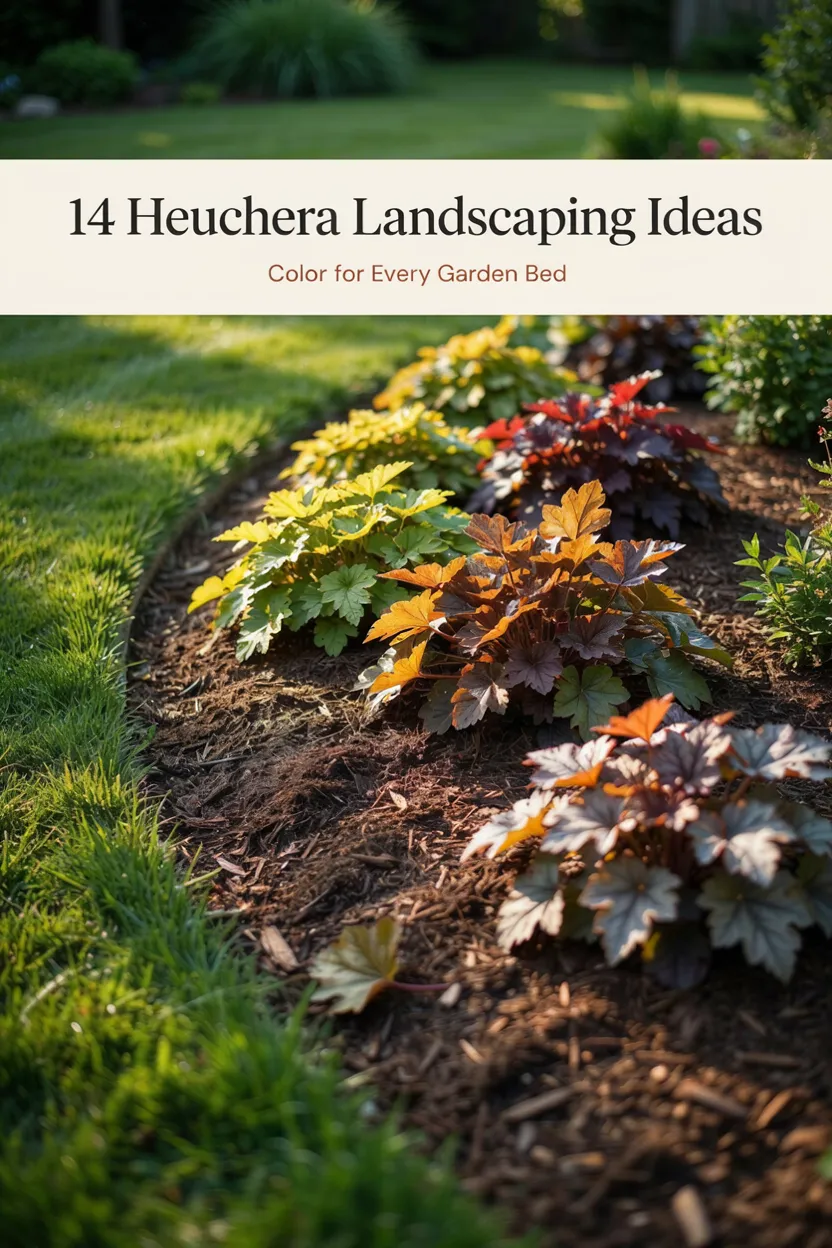
14 Heuchera Landscaping Ideas That Bring Color to Every Garden Bed
Most plants make you wait for flowers to bring color. Heuchera skips the waiting entirely — its leaves are the show, in shades no other perennial dares: caramel, lime, burgundy, silver-veined plum, near-black. Better known as coral bells, this native workhorse holds its foliage nearly year-round, thrives in the shade where color usually gives up, and shrugs off deer, drought, and neglect once established. The real question isn’t whether to grow it, but how to use it well. These heuchera landscaping ideas cover fourteen designs that put those painted leaves to work — rainbow borders, moody black plantings, path edgings, container centerpieces, and winter beds that refuse to go beige. Each includes the pairing and placement details that make heuchera look designed instead of collected. Save your favorites before plant-sale season, because the good cultivars vanish by May. Coral bells are my desert-island perennial — I sneak them into nearly every project.
1. The Rainbow Border That Never Blooms Out
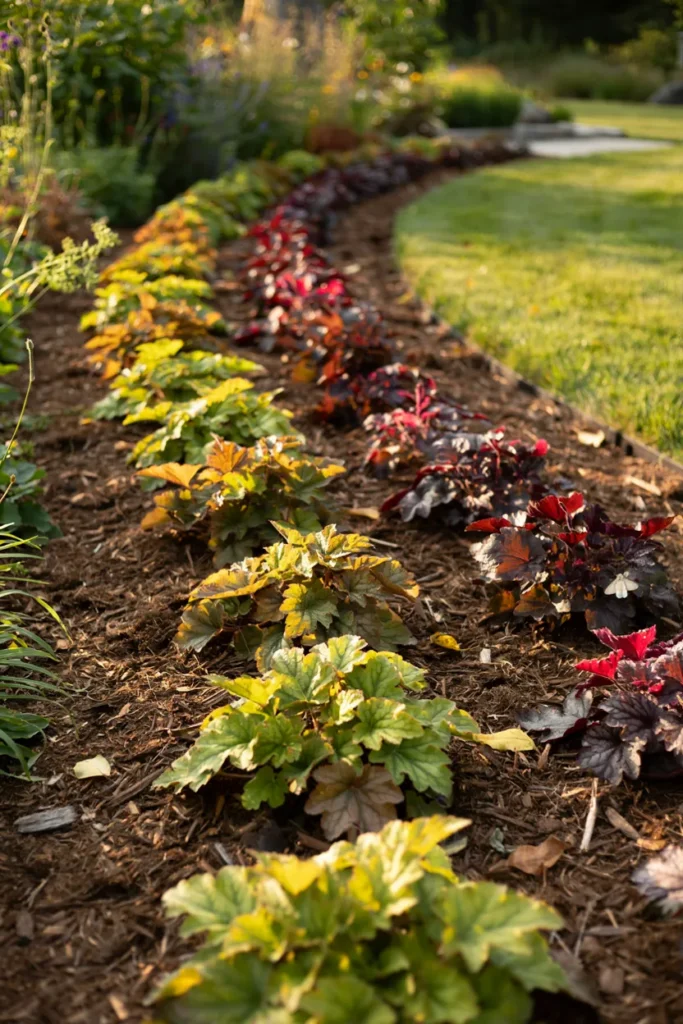
A border built from heuchera alone sounds like a one-note idea until you see the palette: lime, amber, wine, and pewter flowing in drifts like brushstrokes. Because the color lives in leaves, not blooms, the display never cycles off — the border looks finished in April and still finished in November. It’s the closest gardening gets to painting, and it thrives in the part-shade strips where flower borders sulk.
Plant in drifts of three to five per cultivar rather than alternating singles, which reads as static. Anchor with a repeating dark variety — ‘Obsidian’ or ‘Palace Purple’ — every few feet so the brights have contrast, and let lime cultivars like ‘Lime Rickey’ carry the glow. Space fifteen inches apart over dark mulch; the black background makes every color pop harder.
2. The Shade Trio: Heuchera, Hosta, Fern
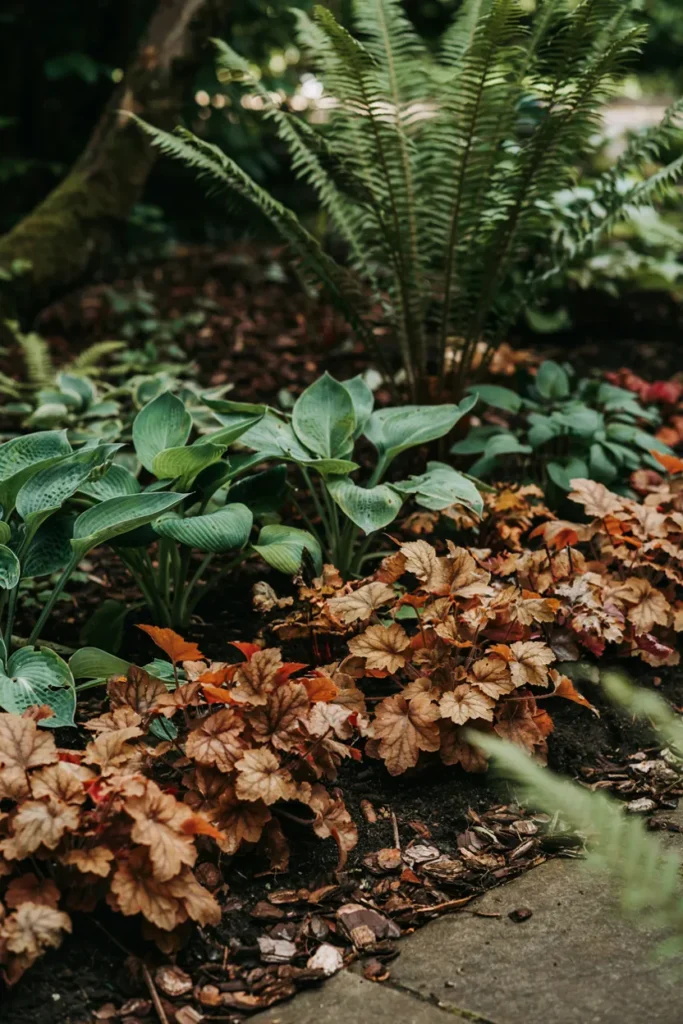
Shade gardening’s most reliable recipe is a texture argument: heuchera’s ruffled mounds, hosta’s broad paddles, ferns’ feathered arcs. Three completely different leaf shapes means the eye never gets bored, even in a single green-and-caramel palette. Heuchera plays the color role in the trio, a caramel or wine cultivar glowing against all that blue-green, and the combination looks intentional from the first season.
Layer by height: ferns at the back, hostas mid-bed, heuchera at the front edge where its color reads. One caramel variety like ‘Caramel’ against blue hostas is the classic; wine-dark ‘Forever Purple’ turns the same bed moody. Repeat the trio in clusters down the bed rather than planting one of each. All three want the same moist, rich shade — one watering zone, zero negotiation.
3. A Container Thriller That Handles Shade Porches
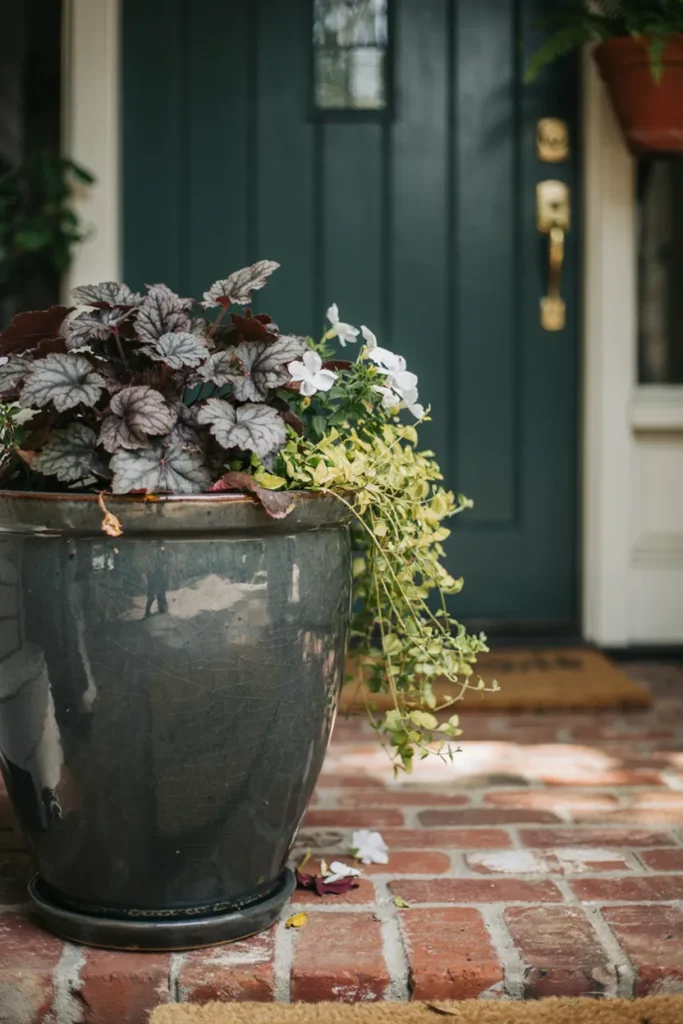
Shade porches doom most container flowers to leggy disappointment — heuchera is the exception that looks better there. A silver-plum cultivar as the pot’s centerpiece delivers metallic drama no annual can match, holds its looks from frost to frost, and comes back next year while the petunias compost. One good heuchera container beats six struggling flower pots, and the porch finally gets its statement.
Choose a bold-leafed variety — ‘Silver Scrolls’, ‘Plum Pudding’, ‘Caramel’ — centered in a pot at least fourteen inches wide, ringed with a trailer like creeping jenny and one white shade annual for froth. Morning sun, afternoon shade is the sweet spot. In cold zones, slide the pot against the house wall for winter or heel the heuchera into a bed; it returns for years.
4. Edge the Path in One Repeated Color
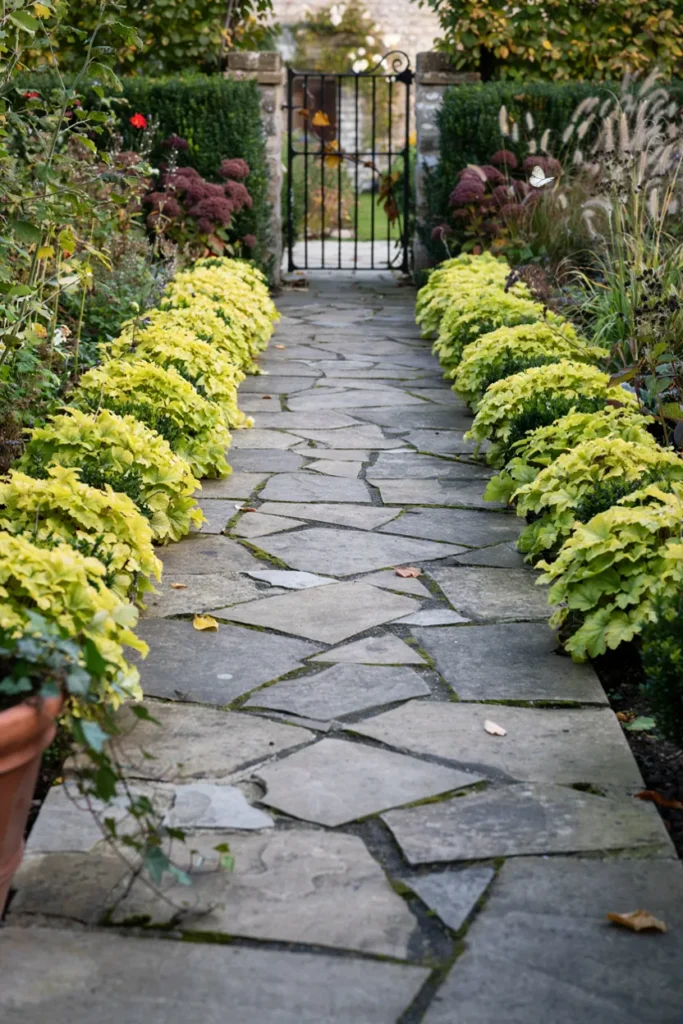
Repetition is the cheapest luxury in garden design, and heuchera makes it easy: one lime cultivar repeated every foot along a path becomes a glowing ribbon that guides the eye — and the feet — exactly where you want them. Unlike flowering edgers that pulse on and off, the chartreuse line holds from spring to hard frost, lighting shaded walkways like landscape lighting that photosynthesizes.
Pick one cultivar and buy enough to finish — mixing dilutes the effect. ‘Lime Marmalade’ or ‘Citronelle’ glow brightest in shade; darker paths can take ‘Caramel’ warmth. Plant twelve inches from the path edge at twelve-inch spacing for a continuous line by year two. Shear spent flower stems in summer to keep the ribbon crisp. Divide every third spring and the edging extends itself free.
5. Naturalized Drifts Under the Trees
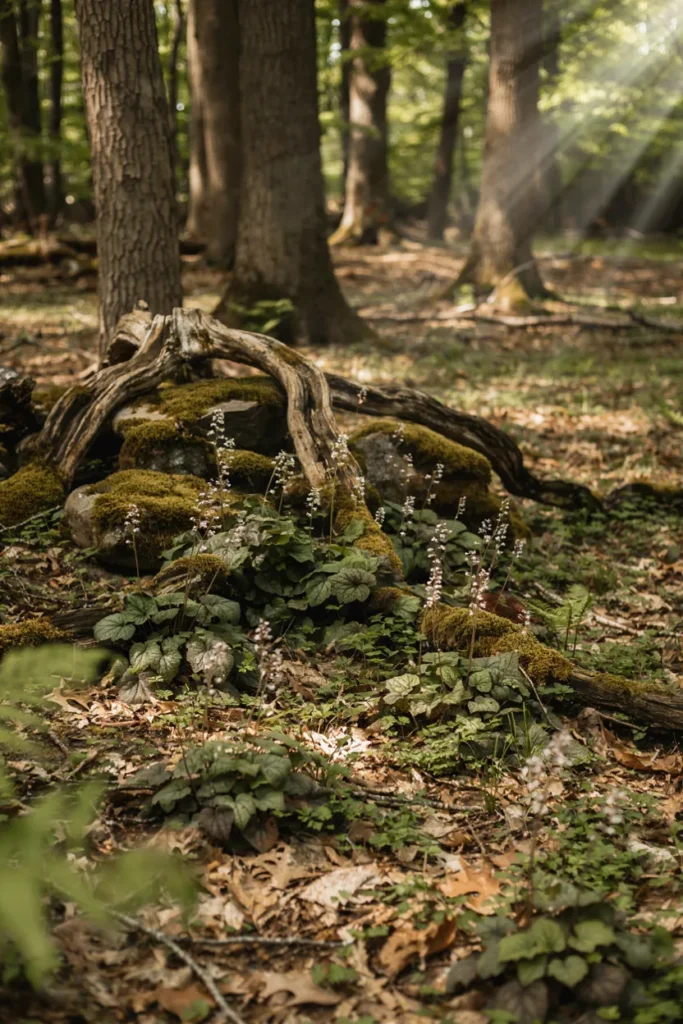
Before it was a designer plant, heuchera was an American woodland native — and it still remembers. Drifted informally under trees, species types and near-species cultivars weave between roots and rocks like they seeded themselves, sending up airy wands of tiny bells each spring. It’s the lowest-effort deployment on this list: plant, mulch with leaves, and let the woodland edge landscape itself.
Choose species-close varieties — Heuchera americana, villosa types, ‘Autumn Bride’ — over highly bred colors, which look airbrushed in wild settings. Plant in loose clusters of five to nine, denser near paths and thinning outward, exactly as nature scatters. Leave fall leaves as mulch. Companion them with native ferns and foamflower, their natural neighbors, and the planting reads as discovered rather than installed.
6. Black Leaves Against Silver Neighbors
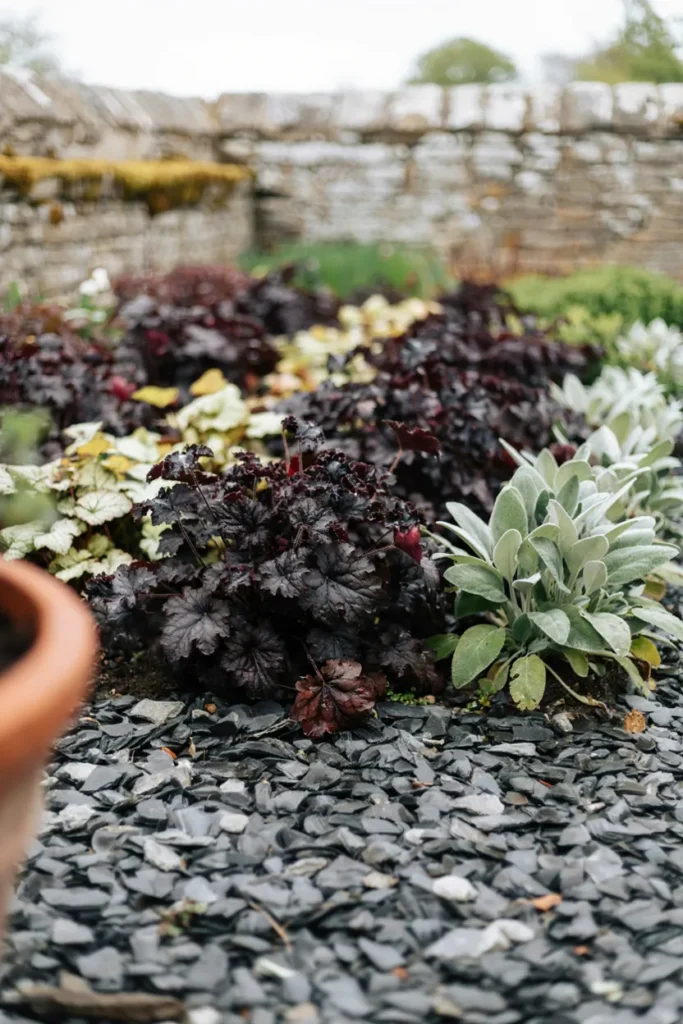
Nothing in the perennial world does black like heuchera — and black needs silver to be seen. Pair ‘Obsidian’ or ‘Black Pearl’ against lamb’s ear and silver brunnera, and both sides of the contrast intensify: the black reads deeper, the silver nearly white. It’s the plant pairing equivalent of a tuxedo, and it makes even a three-foot corner bed look like considered design.
Plant blacks in odd-numbered groups with silver partners surrounding — lamb’s ear, ‘Jack Frost’ brunnera, artemisia, or dusty miller in sunnier spots. Pale gravel or slate mulch doubles the drama; brown bark mulch swallows it. This combination peaks in overcast light and evening, exactly when gardens get used, and one white-flowered bulb layer in spring completes the formal look.
7. Jewel Pockets in the Rock Garden
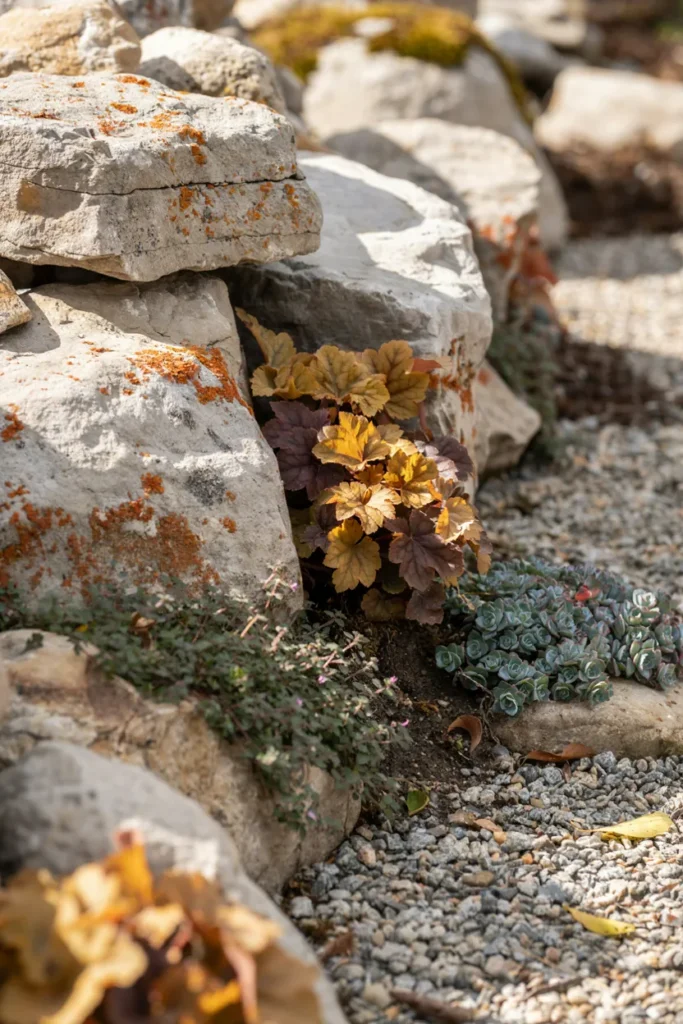
Rock gardens run on contrast between hard and soft, and heuchera’s ruffled rosettes tucked into stone pockets play the soft role beautifully — amber and plum leaves glowing against gray limestone like set gemstones. The crevice life suits them: sharp drainage, cool root runs under rock, and protection from winter wet, which kills more heuchera than cold ever does.
Plant smaller cultivars — ‘Marmalade’, villosa dwarfs — into generous soil pockets on the rockery’s shadier faces, east and north sides ideally. One plant per pocket, repeated across the slope, beats crowding. Grit the crown level with soil to shed water off the rosette. Companions stay low: thyme, sedum, dwarf fescue. The stones supply winter interest when the heuchera rests.
8. A Single-Variety Ribbon Through the Bed
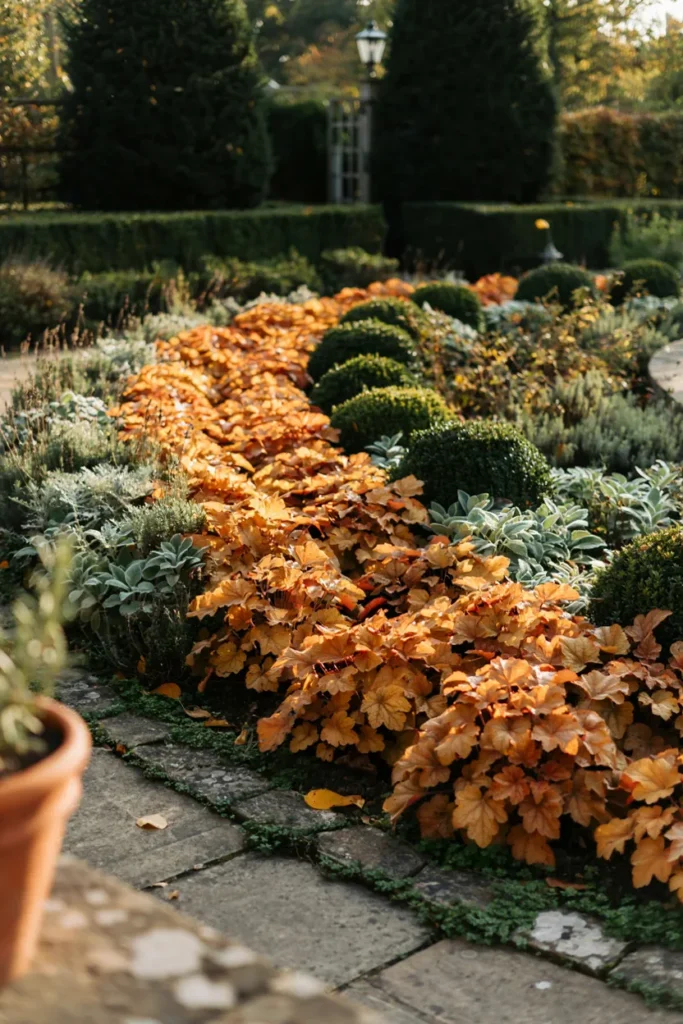
Professional plantings look professional for one repeatable reason: quantity of one thing, not one of many things. A ribbon of a single caramel or wine heuchera — fifteen, twenty-five plants — snaking through a shrub bed creates a river of color that reads from across the yard, unifying whatever mixed greenery it passes through. It’s the move landscape designers bill for, executable with one flat from the nursery.
Draw the curve first with a hose, generous and lazy, then plant along it at twelve-inch spacing. Choose the variety by backdrop: ‘Caramel’ warms dark evergreens, ‘Obsidian’ grounds golden shrubs, ‘Georgia Peach’ glows against anything. Buy small — quarts knit into the ribbon within two seasons at half the cost. Resist adding a second color; the discipline is the design.
9. Front-Row Seats for the Rose Bed
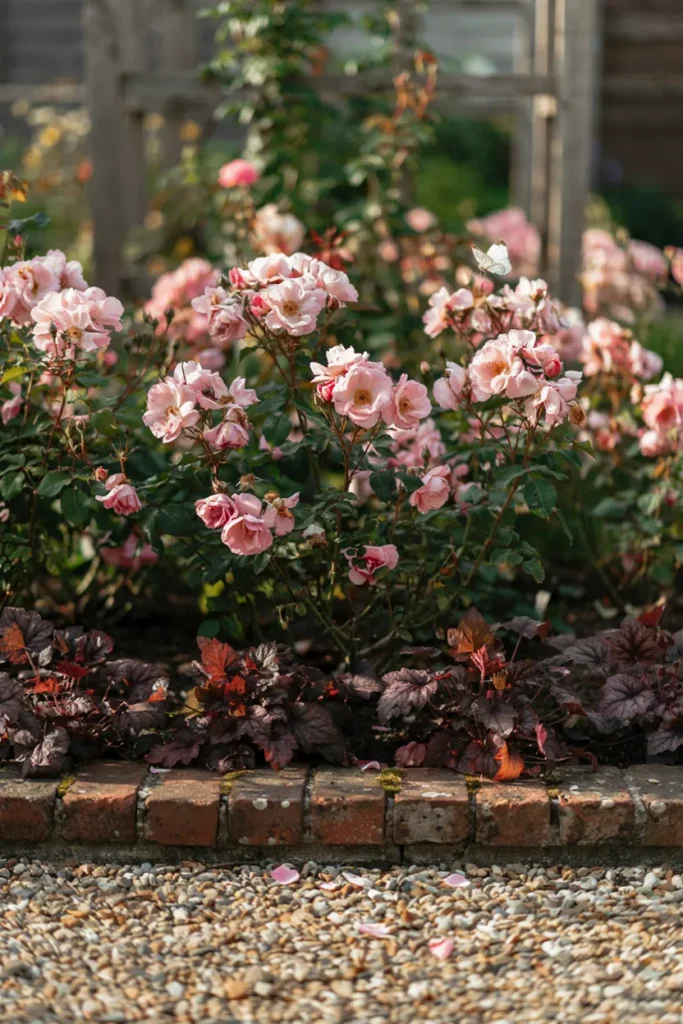
Roses have famous ankles — bare, thorny, and best hidden. A front row of plum heuchera solves the problem with style: dark ruffled mounds skirting the rose bed year-round, making pink and apricot blooms float above rich burgundy instead of mulch and canes. The pairing is old English garden wisdom, and it works because the heuchera performs during every week the roses take off.
Plant wine-dark varieties eighteen inches out from rose crowns to share water without crowding airflow. ‘Palace Purple’, ‘Plum Pudding’, and ‘Wildberry’ flatter every rose color; lime cultivars suit white and red roses. Both plants take the same feeding schedule, and the heuchera’s June flower sprays — airy cream wands — arrive exactly as the first rose flush peaks. Coincidence, but take credit anyway.
10. Window Boxes for the Shady Side
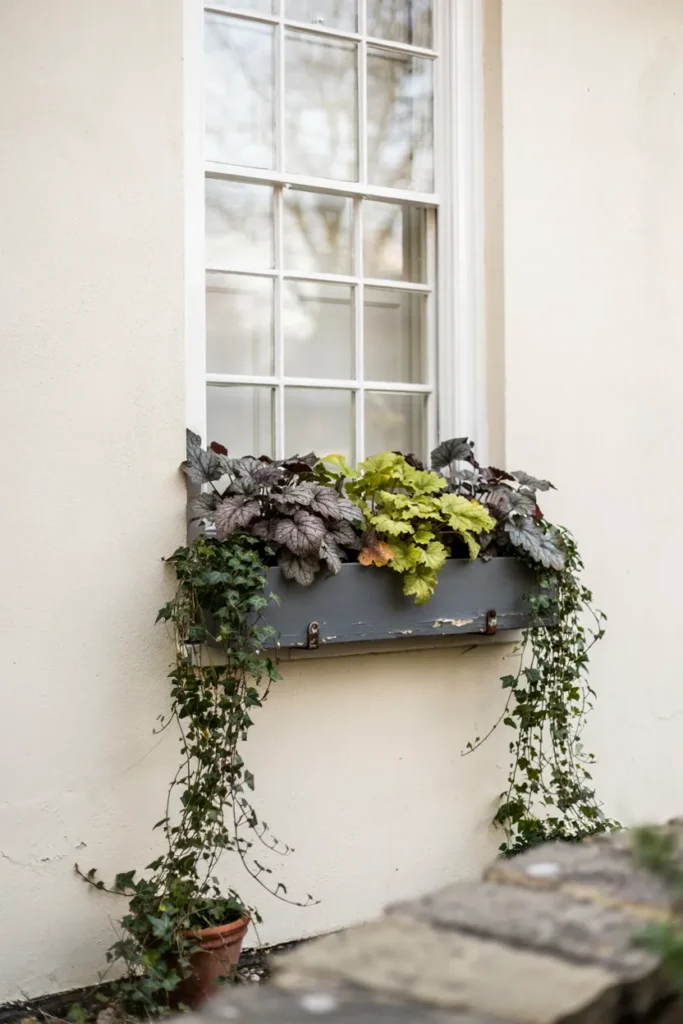
North-facing window boxes are where geraniums go to disappoint. Heuchera flips that equation: the shade side becomes the best-dressed windows on the house, filled with metallic plum and lime ruffles that hold their color without an hour of direct sun. As a bonus, the display survives winter in most zones — window boxes that look planted in January are their own quiet flex.
Alternate two contrasting cultivars — silver-plum with lime reads richest — at three plants per standard box, ivy trailing the corners. Use quality potting mix and water weekly; boxes dry faster than beds even in shade. Every second spring, lift, divide, and replant the strongest rosettes. The same box scheme repeated at every shaded window turns a problem side of the house into signature.
11. The Bed That Refuses Winter

In most climates heuchera is semi-evergreen, holding its painted leaves through frost, snow dustings, and the long beige months when gardens surrender. Built into a winter-interest bed — conifers behind, red-twig dogwood for stems, heuchera carrying the ground floor — it delivers actual color in January, not the “texture” gardeners settle for. Frost on a plum heuchera leaf is a legitimate destination view.
Villosa-blood cultivars hold winter foliage best; site them sheltered from desiccating wind and avoid soggy winter soil, their one true enemy. Skip fall cleanup — the old leaves protect the crown — and tidy in earliest spring instead. Position the bed where winter windows face it. Companions: dwarf conifers, hellebores, snowdrops, and dogwood stems for the full January show.
12. Hold the Slope, Colorfully
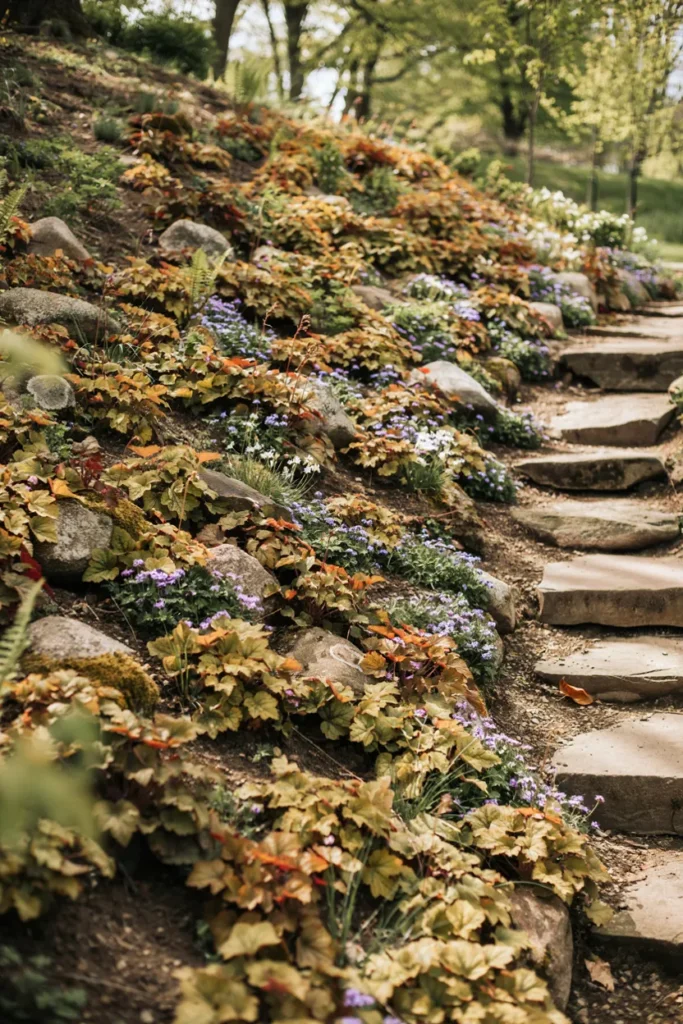
Shaded slopes shed mulch, drown grass, and defeat most groundcovers that promise otherwise. Heuchera’s dense, fibrous crowns grip grade surprisingly well, and massed with foamflower — its natural cousin — they knit a colorful carpet that holds soil while looking far better than any erosion blanket. The slope becomes a feature bed you never mow and rarely touch.
Plant across the slope in staggered rows on twelve-inch centers, heuchera and foamflower alternating, with fieldstones seated here and there as anchors and foot access. Villosa types handle the tougher, drier upper slope; save richer spots below for fancy colors. Pin landscape fabric only on steep sections. Two seasons to full knit; after that, gravity works for the plants instead of against you.
13. The All-Dark Modern Moment
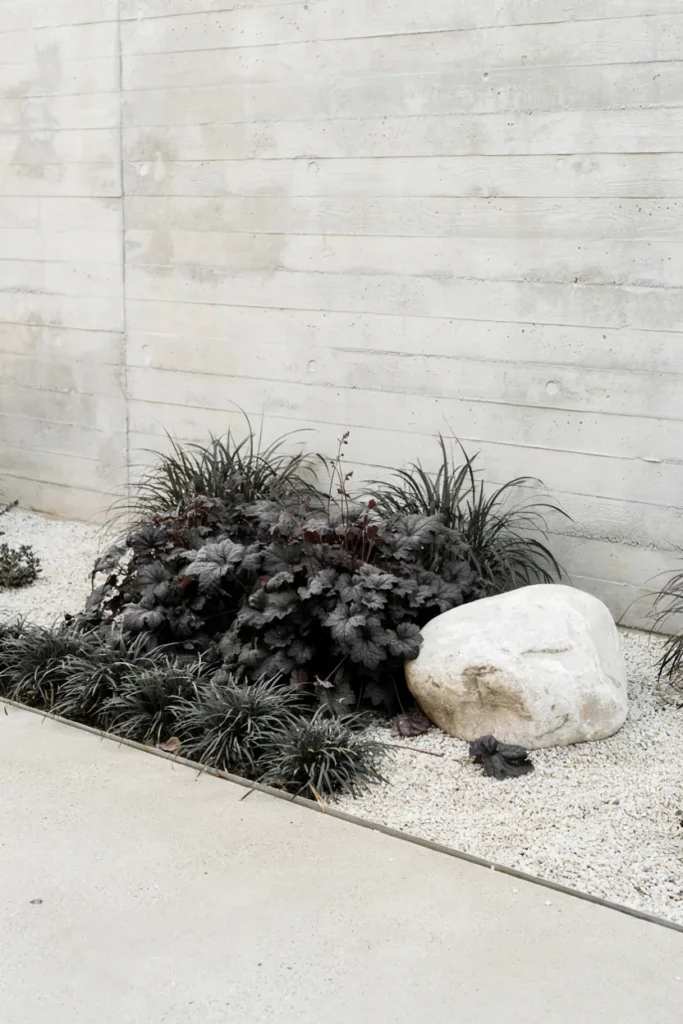
For modern architecture, plant like the building talks: low, dark, disciplined. A monochrome bed of near-black heuchera, black mondo grass, and bronze carex against pale gravel reads as pure design — foliage as material, no flowers required. It’s the rare planting that improves concrete and standing-seam siding, and its restraint photographs like the cover of an architecture annual.
Mass ‘Black Pearl’ or ‘Obsidian’ in blocks, mondo grass ribboning between, over crushed pale granite that makes the darkness graphic. Keep the palette to three plants maximum and repeat generously. One pale boulder or corten edge supplies the counterpoint. Shear heuchera flower wands off if they interrupt the line — in this bed, discipline outranks blossoms.
14. Let the Bells Feed the Hummingbirds
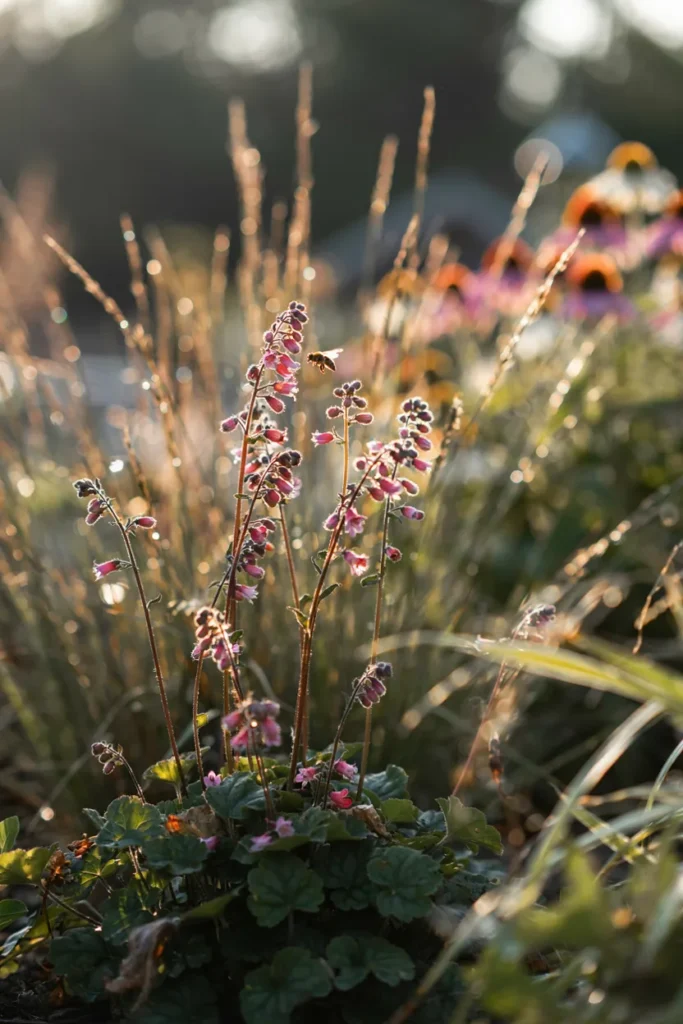
The “coral bells” name comes from the part modern gardeners ignore: slender wands of tiny bells that hummingbirds treat as scheduled stops. Species types and coral-flowered cultivars bloom generously for weeks, feeding early pollinators when little else offers nectar. In a native or pollinator border, heuchera earns its place twice — painted leaves below, working flowers above.
For flower power choose bloom-focused varieties — sanguinea types, ‘Firefly’, ‘Coral Forest’ — over the leaf-first hybrids that bloom shyly. Weave them mid-border among native grasses and coneflowers where the airy wands catch backlight. Deadhead once for a second flush, then let final stems stand for seed. Site a bell cluster near a window; the hummingbird traffic is appointment viewing.
Conclusion
Every garden has a spot that stays stubbornly dull — too shaded for flowers, too visible to ignore, too small to justify a redesign. Heuchera exists for exactly those spots, and for most of the others too. Leaves that outperform blooms, a palette from lime to near-black, native toughness, and a footprint that fits window boxes and hillsides alike: few plants stretch across this many of these heuchera landscaping ideas without repeating themselves. The strategy that unites all fourteen is simple — treat foliage as your color source, repeat varieties boldly instead of collecting singles, and give every dark leaf a pale neighbor to argue with. Save your favorite combinations to your Pinterest boards before spring fever hits the nurseries, then start with one ribbon, one border, or one good pot by the door. By the second season, you’ll understand why designers call coral bells the shade garden’s box of paints.