16 Mud Kitchen Ideas That Make Outdoor Play More Fun and Creative
Ask any early-childhood teacher about the best outdoor toy ever invented and most will give the same unglamorous answer: mud. A mud kitchen — part play stove, part science lab, part restaurant that only serves pies made of dirt — turns that messy magic into hours of self-directed play, the kind that builds imagination while you drink your coffee in peace. The best mud kitchen ideas don’t require carpentry skills or big budgets; old pallets, a thrifted cabinet, and some hand-me-down pots cover most builds. This guide collects sixteen ways to build, theme, and upgrade one, from working water pumps to fold-down kitchens for tiny yards, plus the practical bits parents actually need: heights, weatherproofing, and cleanup stations that save your washing machine. Save your favorites, raid the garage, and prepare for a summer of exquisitely garnished mud soup. Fair warning from experience: you will absolutely end up tasting the pretend soup.
1. The Classic Pallet Build With a Real Sink
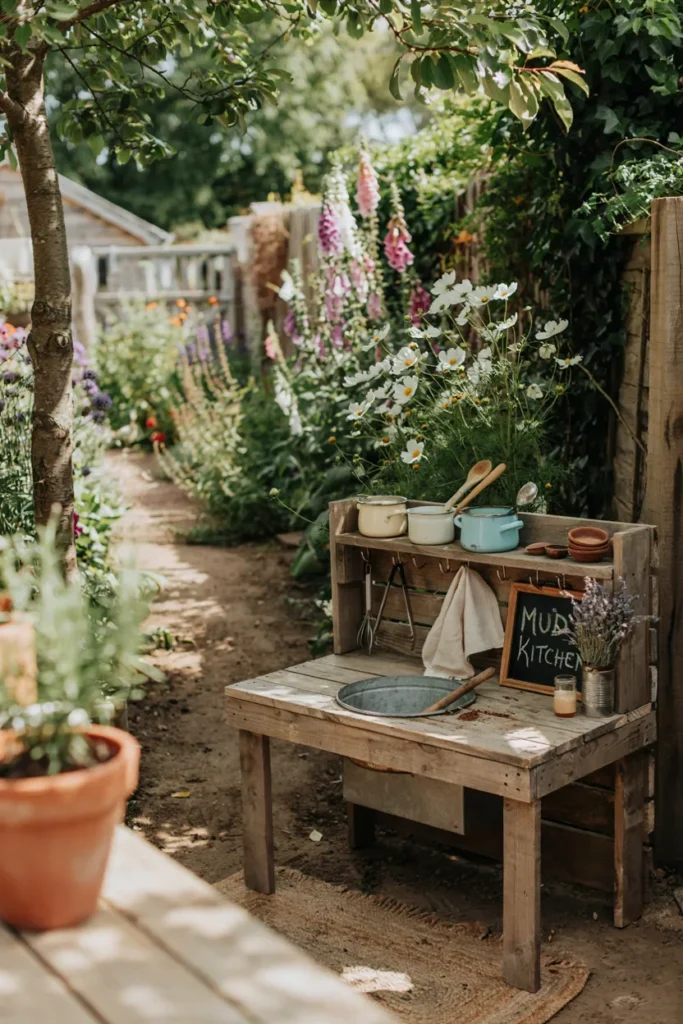
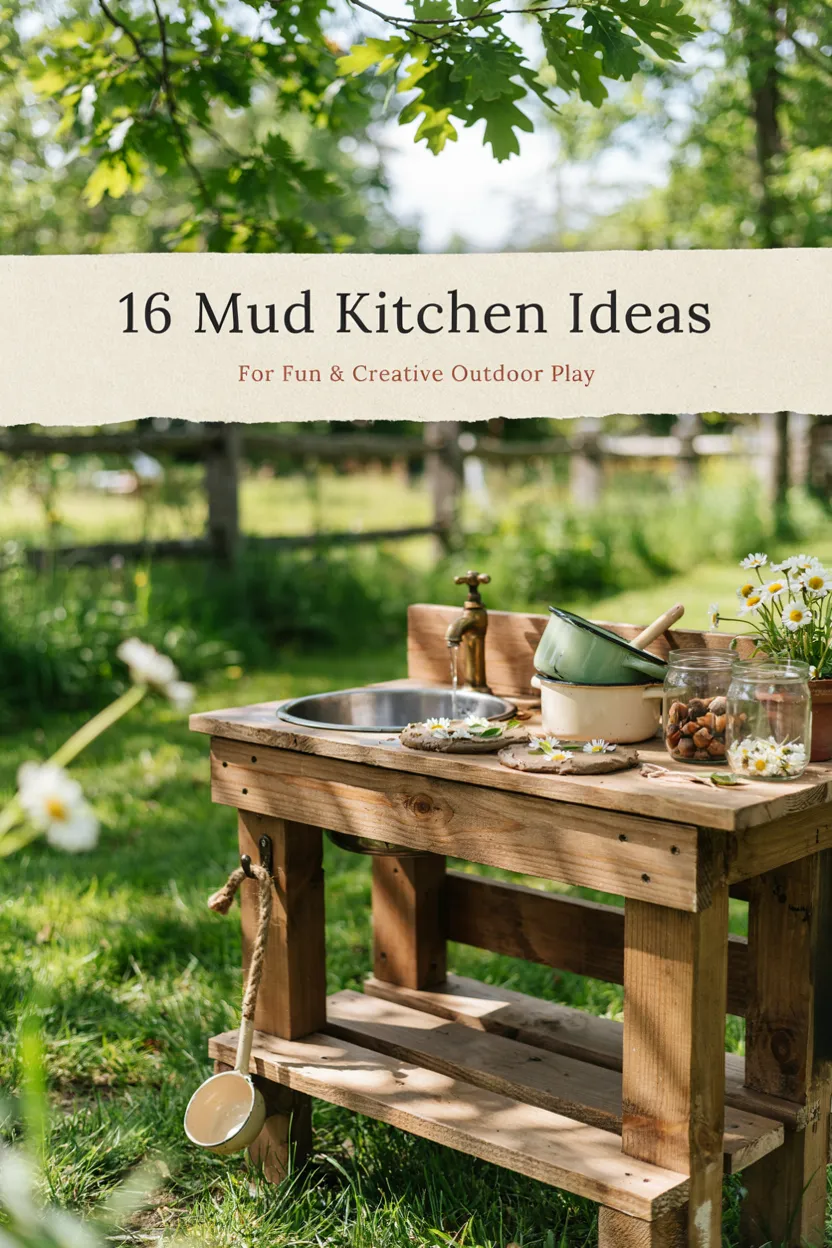
The pallet mud kitchen is the genre’s founding recipe for good reason: free materials, forgiving construction, and a finished look that belongs in a storybook garden. A counter at kid height, a basin dropped into a cut-out, a shelf for pots, hooks for spoons — that’s the whole architecture. Children treat the sink hole like a professional station, and the rough wood only gets more charming as mud seasons it.
Two heat-treated pallets yield the frame; a third donates shelf boards. Cut the counter opening to fit a metal mixing bowl or cheap washing-up basin so it lifts out for dumping. Sand every reachable edge twice — mud kitchens get gripped, climbed, and leaned on. Finish with raw linseed oil rather than paint if you want the fairy-tale weathering. Total cost: often just the screws.
2. Upcycle a Real Kitchen Cabinet
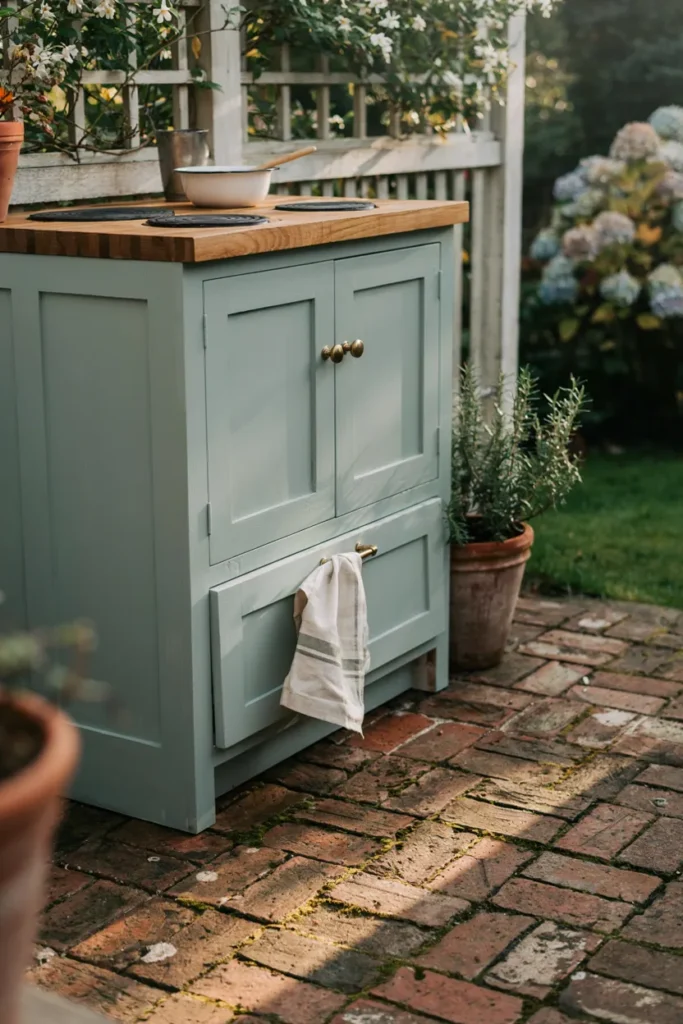
Renovation season leaves perfectly good base cabinets on curbs everywhere — and a base cabinet is already a mud kitchen wearing indoor clothes. Doors become the oven, drawers hold the spoon collection, and the counter arrives pre-installed. One coat of cheerful exterior paint later, the cast-off looks intentional, and kids get the deeply satisfying realism of a kitchen that works exactly like the one inside.
Hunt curb alerts, habitat stores, and renovation dumpsters for solid-wood or well-built units; avoid swollen particleboard. Prime and paint every surface with exterior paint, seal the top, and set the whole piece on pavers or feet so the base never sits in wet grass. Paint burner circles on the counter, add a salvaged knob or two, and hang a tea towel — realism is the theme kids notice most.
3. A Working Hand Pump for Real Running Water
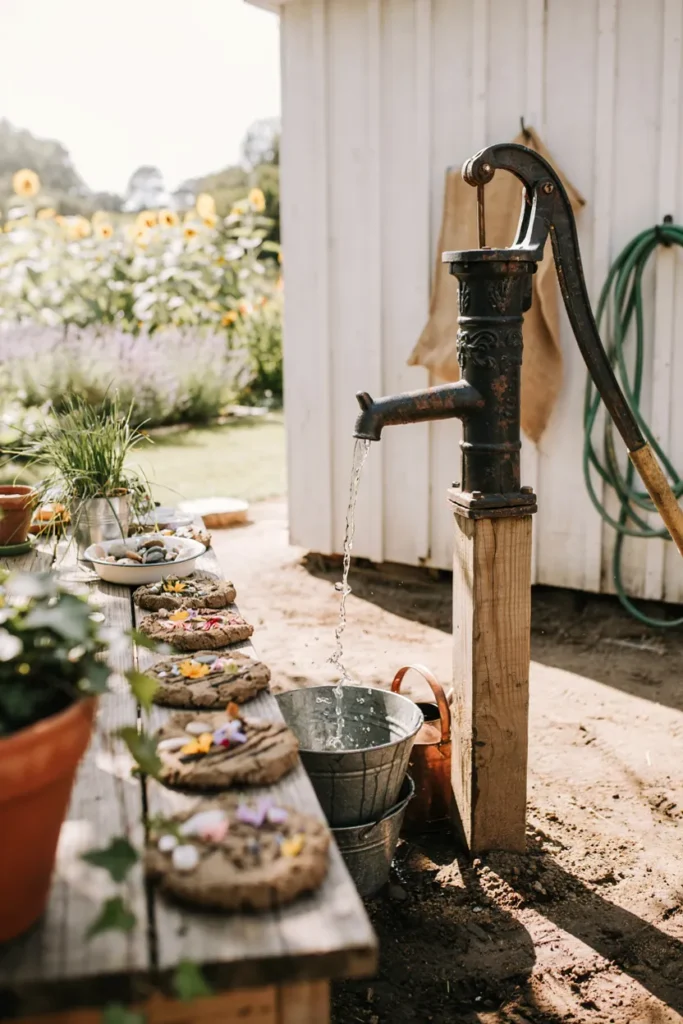
Water access is the difference between a mud kitchen that gets visited and one that gets lived in. A hand pump — the old-fashioned lever kind — turns water into part of the play itself: kids pump, haul, measure, and pour on repeat, learning cause and effect with every squeaky stroke. No standing hose bill, no tap left running, just a finite bucket refilled with glorious effort.
Budget garden hand pumps recirculate from a hidden bucket or barrel below — no plumbing, under fifty dollars. Mount it on a post or the kitchen’s end panel over a catch basin, and let overflow drain to a gravel splash zone so the area doesn’t swamp. Refill mornings; the effort of pumping naturally rations water better than any parental nagging ever has.
4. The Mud Café With a Chalkboard Menu
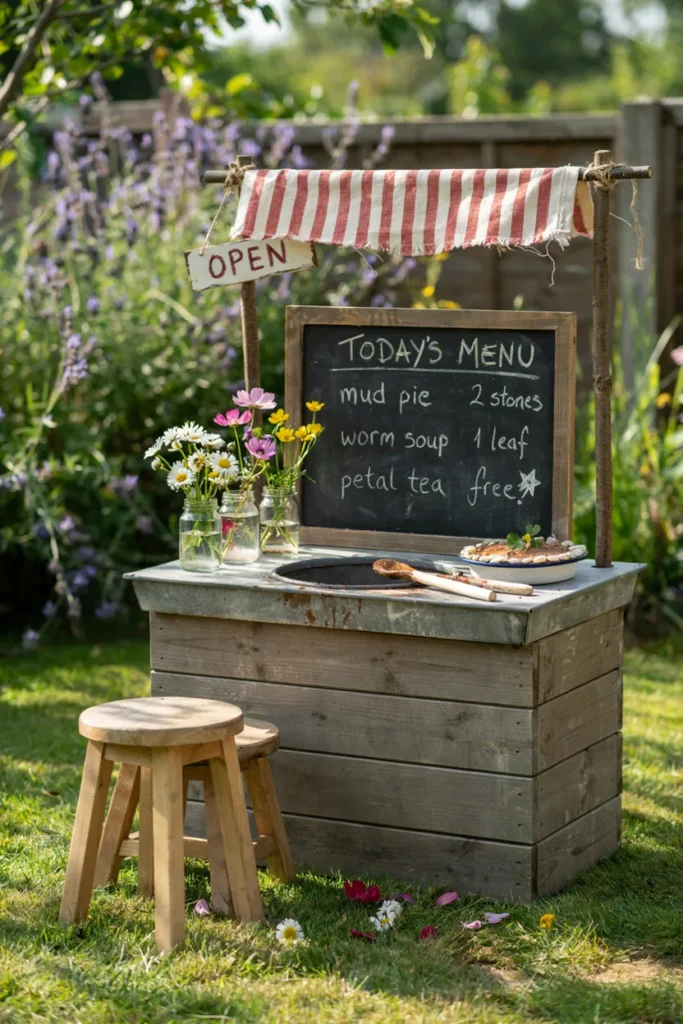
Add a menu and everything changes: the mud kitchen becomes a café, and suddenly there are roles — chef, waiter, customer, health inspector on bad days. A chalkboard listing worm soup and petal tea invites literacy through play, while a serving counter with stools on the “customer side” pulls siblings and visiting adults into the game. Restaurants run on imagination; this one just also runs on mud.
Mount a chalkboard (or chalkboard-painted plywood) above the counter where small arms reach, with a jar of chunky chalk nearby. Create the serving window with a shelf board and two thrifted stools opposite. A striped awning scrap or bunting overhead completes the storefront. Laminated “order pads” and play money extend the game for the checkout-obsessed years.
5. A Nature Pantry of Beautiful Ingredients
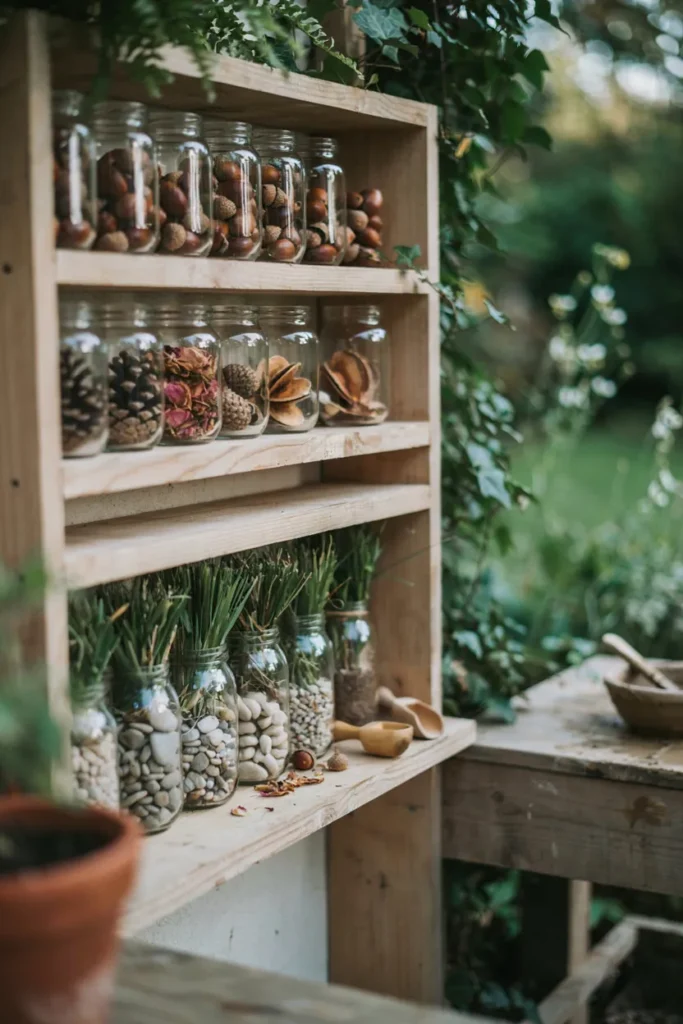
Mud is the batter; nature is the spice rack. A pantry shelf of jars filled with acorns, petals, seed pods, and pebbles transforms slop into recipes — pies get garnished, soups get seasoned, and small hands practice sorting and counting without anyone calling it learning. The jars look so good lined up that this might be the only children’s storage that improves a garden view.
Use plastic or thick glass jars (recycled honey and sauce jars work) on a shelf kids can reach, refilled by the children themselves on nature walks — collecting is half the play. Rotate seasonally: petals in June, acorns in October. Add scoops, an old spice shaker, and a battered muffin tin for portioning. The rule that keeps it alive: ingredients are infinite, jars stay sorted-ish.
6. Two Heights, Zero Sibling Wars
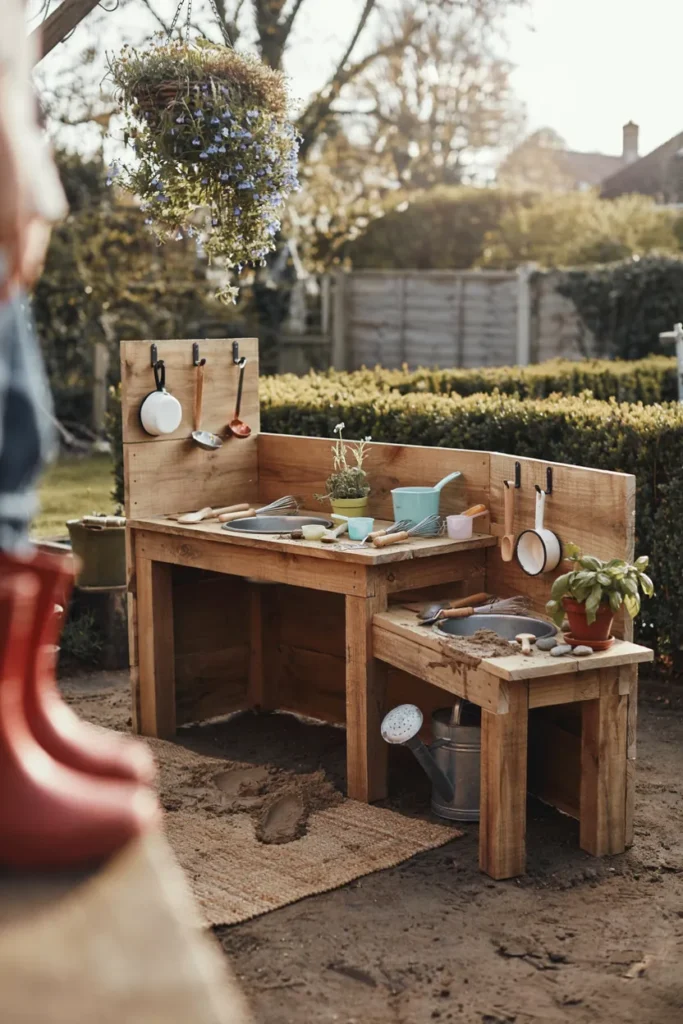
One counter, two kids of different heights: the physics of conflict. A two-tier build — standard counter for the big kid, knee-height extension for the toddler — gives each chef a legitimate station with their own basin and hooks. The magic is in the duplication: two of everything ends the turf war before it starts, and the little one stops climbing things they shouldn’t.
Build the main counter at 22–24 inches for ages four to eight, stepping down to 14–16 inches for the toddler wing. Mirror the equipment exactly — same bowl, same spoon count; children audit ruthlessly. Round the step-down corner where small heads travel. As the toddler grows, the low section converts naturally into a sitting bench or display shelf for finished mud bakes.
7. The Mud Pie Bakery
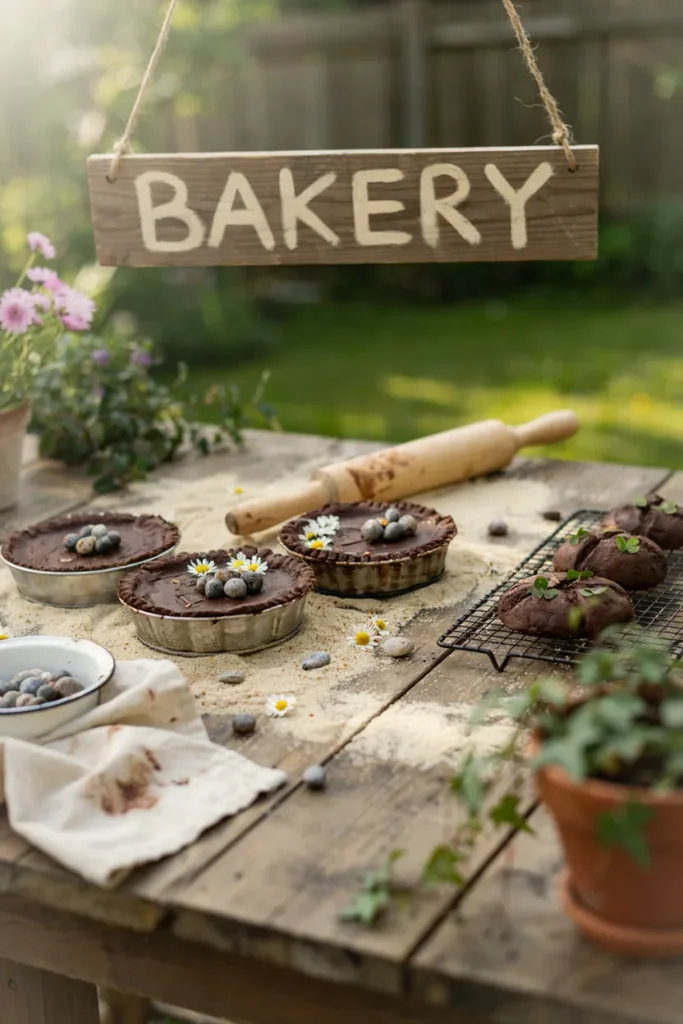
Every mud kitchen drifts toward baking eventually — pies are simply mud’s destiny. Leaning into it with a bakery theme sharpens the play: rolling pins flatten dough, tins shape tarts, a cooling rack displays the day’s output, and petal-and-pebble decoration becomes a genuine art form. The repetition of forming, filling, and finishing builds the same fine motor skills as any craft table, but outside and joyfully filthy.
Thrift the specialist equipment: metal pie tins, a muffin tray, rolling pin, cookie cutters, and a wire cooling rack — a full bakery kit rarely tops fifteen dollars secondhand. Keep a bin of dry sand as “flour” for dusting. A hand-painted BAKERY sign and a bell for the counter turn transactions official. Display shelf mandatory: mud bakers are proud, and the drying pies genuinely look wonderful.
8. The IKEA Hack Kitchen
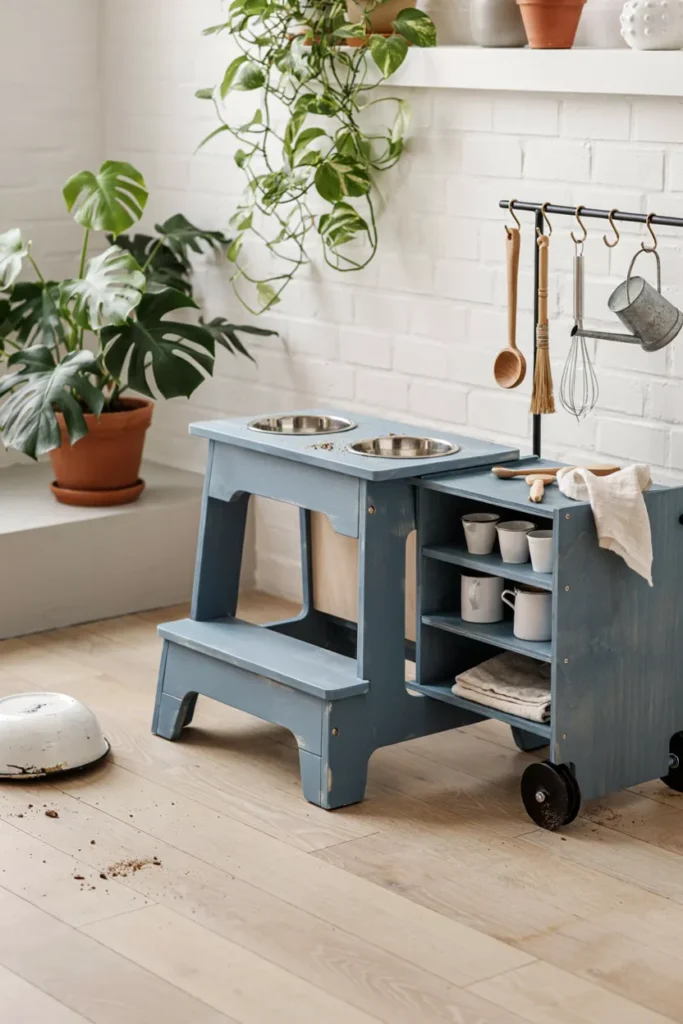
No pallets, no power saw ambitions? Flat-pack pieces hack into mud kitchens beautifully — a wooden step stool becomes a counter with two bowl cut-outs, a utility cart becomes a rolling prep station, and everything arrives square and splinter-free. It’s the cleanest route to a mud kitchen for apartment patios and anyone whose garage lacks a lumber pile, finished in an afternoon including the paint.
The classic recipe: trace two mixing bowls on a BEKVÄM-style stool top, jigsaw the circles (or ask the hardware store to cut), drop in the bowls, and paint everything with exterior enamel. A RÅSKOG-style cart adds wheeled storage that rolls into the shed at night. Add a towel rail and S-hooks. Compact, tidy, and moveable — the city cousin of the pallet build.
9. Go Bold With Color
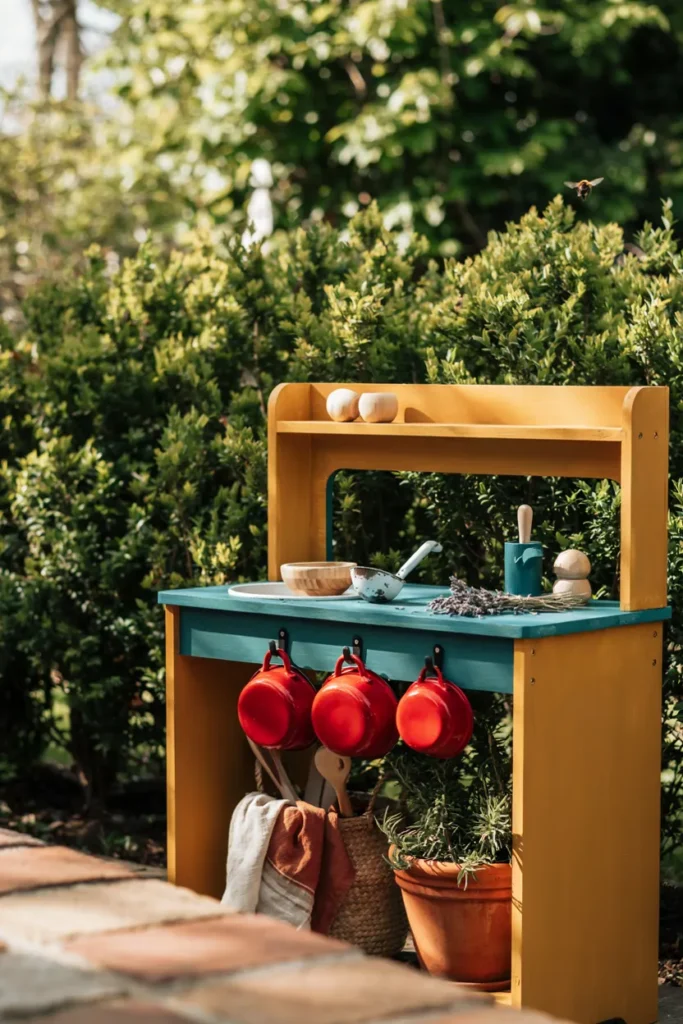
Rustic wood is lovely, but children are not subtle people. A mud kitchen in mustard-and-teal or coral-and-cream announces itself across the yard like a food truck at a festival, and kids respond to the invitation. Bold paint also buys practical wins: exterior enamel seals the wood far better than oil, wipes cleaner, and keeps the build looking loved instead of abandoned through its third winter.
Pick two saturated colors plus one neutral, sample-pot sized — a mud kitchen needs less than a liter of each. Paint the frame one color, counter and shelves the second, rails white. Prime first, two topcoats, and seal the counter with extra care since it takes the scrubbing. Let the kids vote on the palette; ownership of the color doubles usage, a rule as old as bedrooms.
10. Plant a Sensory Herb Border Beside It
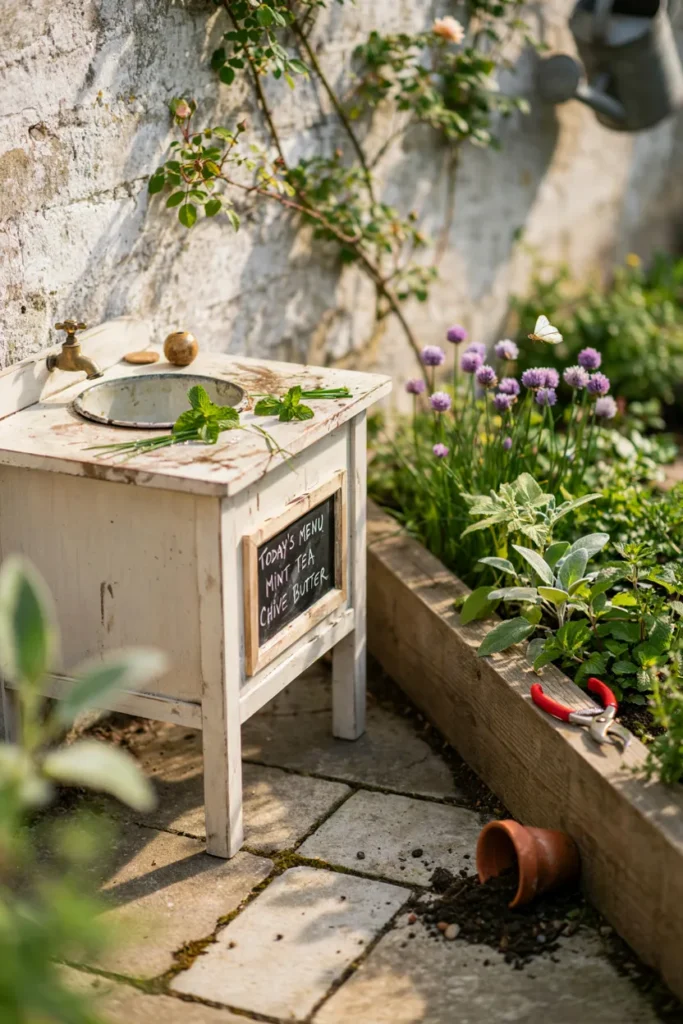
A strip of herbs beside the kitchen upgrades every recipe from mud to cuisine. Mint and lemon balm for tea service, chive blossoms for garnish, lamb’s ear because touching it is the whole point — children harvest, smell, tear, and steep, getting the sensory education gardens are famous for while believing they’re just cooking. It’s also the gentlest introduction to plant care a kid can get.
Plant tough, safe, fast-recovering herbs in a low bed or trough within arm’s reach: mint (contained), lemon balm, chives, thyme, and lamb’s ear for texture. Skip anything spiky or slow-growing — this garden exists to be picked hard. Child-size snips on a hook formalize harvesting. Replant each spring for a few dollars, and accept that the mint will be bald by August. That means it worked.
11. The Potion Laboratory Wing

Around age five, chefs discover alchemy. A potion station — bottles of colored water, funnels, droppers, one dramatic cauldron — channels the mixing obsession into early chemistry: predictions, measurements, color theory, and the eternal question of what happens when everything gets combined. It’s the same mud kitchen energy wearing a wizard hat, and it extends the play years past the pie-making stage.
Stock plastic bottles and jars with water tinted by food coloring, plus funnels, pipettes, a turkey baster, and a thrifted balance scale for gravitas. Vinegar and baking soda live in labeled jars for supervised eruption days. Keep everything shatterproof and refill cheap. An ivy-draped corner and a hand-lettered POTIONS sign supply the atmosphere; imaginations handle the rest.
12. A Pretend Grill for the Backyard BBQ Crowd
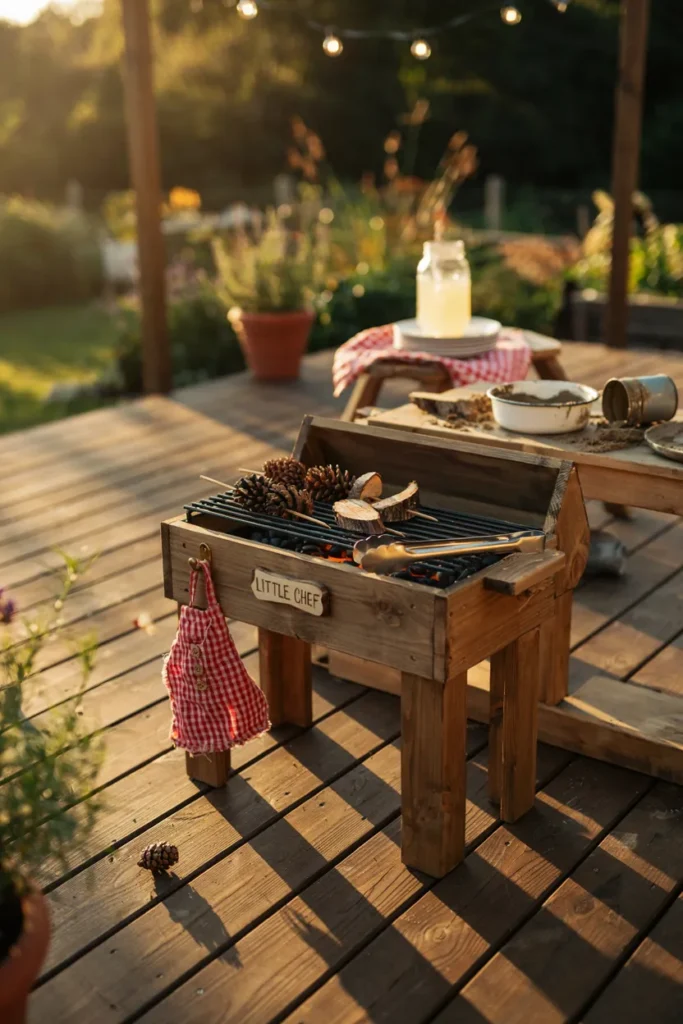
Kids don’t copy what parents say; they copy what parents do — and what parents do all summer is stand at a grill flipping things importantly. A pretend BBQ beside the mud kitchen completes the backyard restaurant: pebble coals, a real grate, pinecone kebabs, bark steaks seared to perfection. The tong work alone provides twenty minutes of deep concentration per cookout.
Build a simple box on legs, fill the bed with black and orange painted pebbles for eternal coals, and top with a cooling rack or salvaged (never used-with-fire) grate. Toy tongs, a child apron, and a squeeze bottle of water “sauce” complete the kit. Position near the real grill so weekend cookouts run in parallel — the mirroring is the entire enchantment.
13. The Fold-Down Kitchen for Tiny Yards
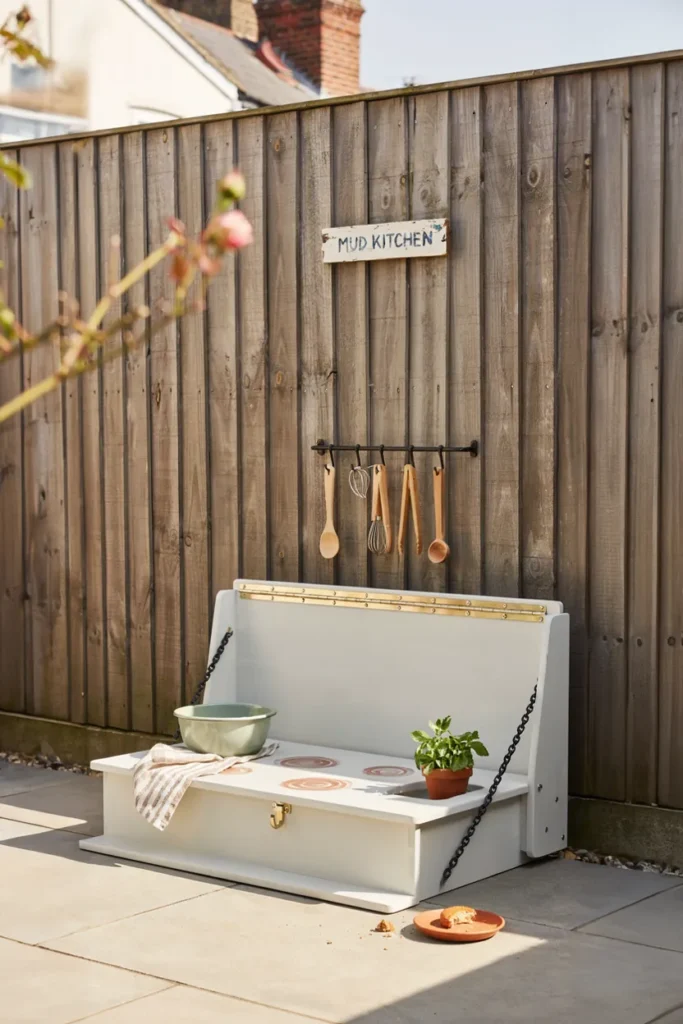
No yard is too small for mud. A fold-down kitchen — hinged counter mounted to the fence, dropping flat when play ends — delivers the full experience in zero permanent footprint. Open, it’s a workstation with basin and burners; closed, it’s a tidy panel that patio furniture can live against. Renters and courtyard families, this is your build: the entire kitchen occupies one fence board’s depth.
Hinge a plywood counter to a fence rail or wall cleat at kid height, supported open by chains or folding brackets rated for leaning weight. Cut one basin hole, paint burner circles, and mount utensil hooks on the fence behind. Everything must stow inside the closed profile, so choose flat tools. A hook-and-eye latch keeps it shut against wind and ambitious toddlers.
14. A Covered Corner That Plays Through Drizzle
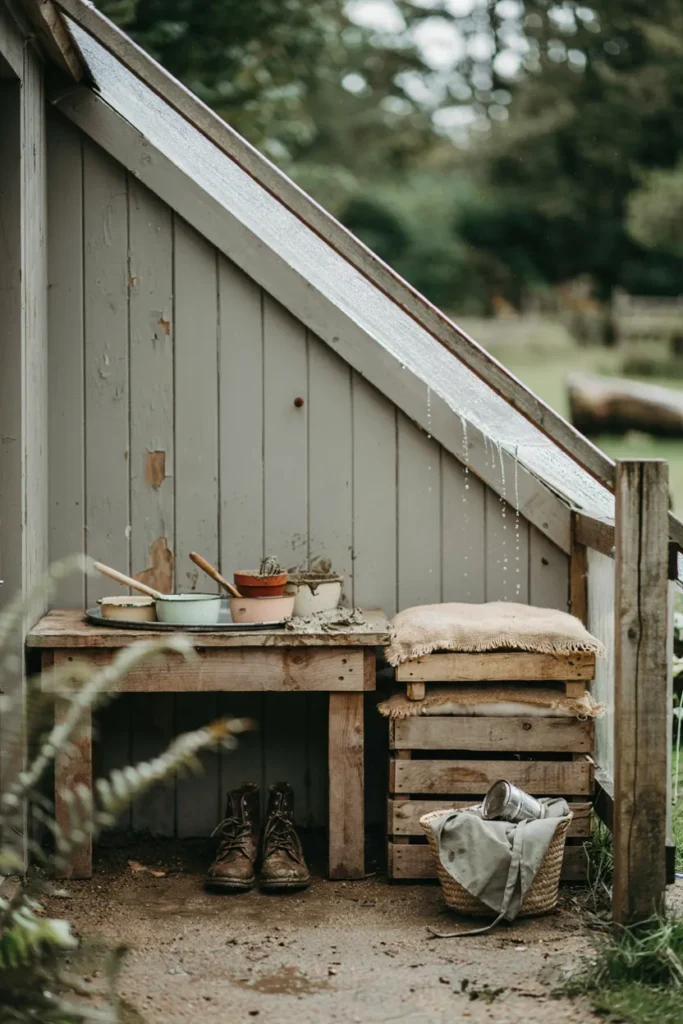
Mud play is objectively better in drizzle — richer materials, fewer mosquitoes, that den-like coziness of being dry while weather happens nearby. A simple roof over the kitchen corner makes rainy-day sessions official instead of forbidden, protecting the build itself in the bargain. Some of childhood’s best hours happen under exactly this kind of shelter, stirring puddle soup while boots fill with rain.
Span clear polycarbonate or corrugated panels between a shed wall and a single post, pitched to shed water away from the play zone. Cover the kitchen plus a seat’s worth of extra space. Add crate seating, hooks for wet coats, and a boot line at the drip edge. The roof also shields the wood from the worst weathering, roughly doubling any build’s handsome years.
15. The Cleanup Station That Saves Your Laundry
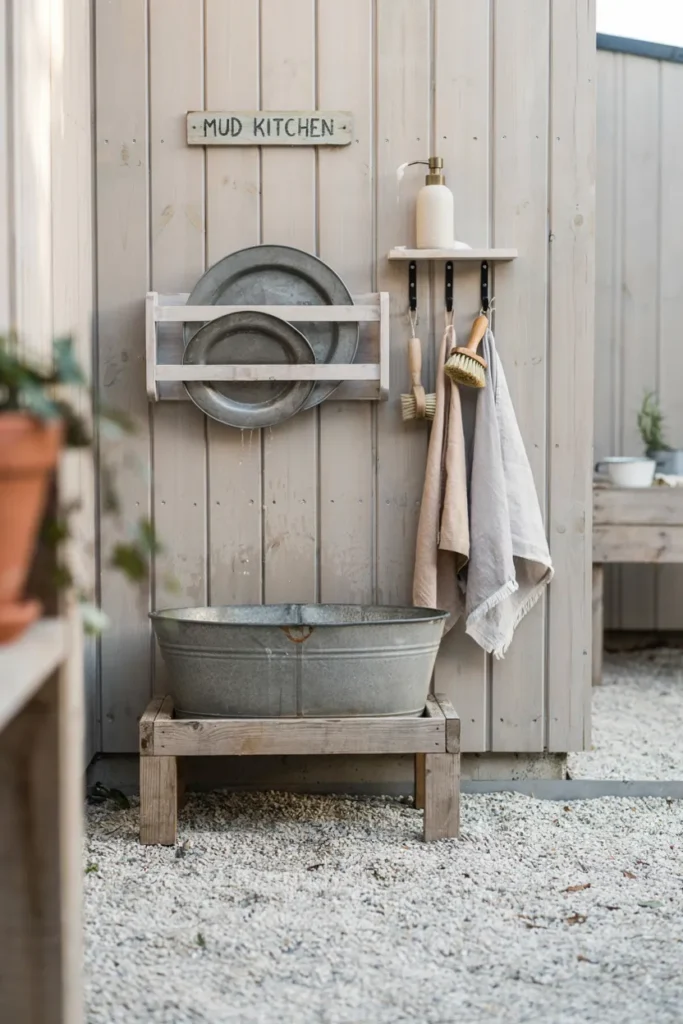
The mud kitchen’s dirty secret is the aftermath — pots crusted like archaeology, towels sacrificed, one parent hosing a colander at dusk. A cleanup station makes washing part of the game: a wash tub at kid height, dish rack, brushes, and towels on hooks. Children genuinely love washing up when it’s their restaurant’s closing routine, and every plate they scrub is one that never enters your kitchen.
Set a galvanized tub on a stand beside the kitchen with a foaming soap pump (one squirt doctrine), two brushes, and a wall rack where washed tins drain overnight. Gravel underfoot swallows the splash zone. Institute the closing ritual early: kitchen closes when dishes rack. It sticks better than any tidy-up song, and the rack of drying tin plates looks unreasonably charming.
16. Winterize It Like a Proper Restaurant
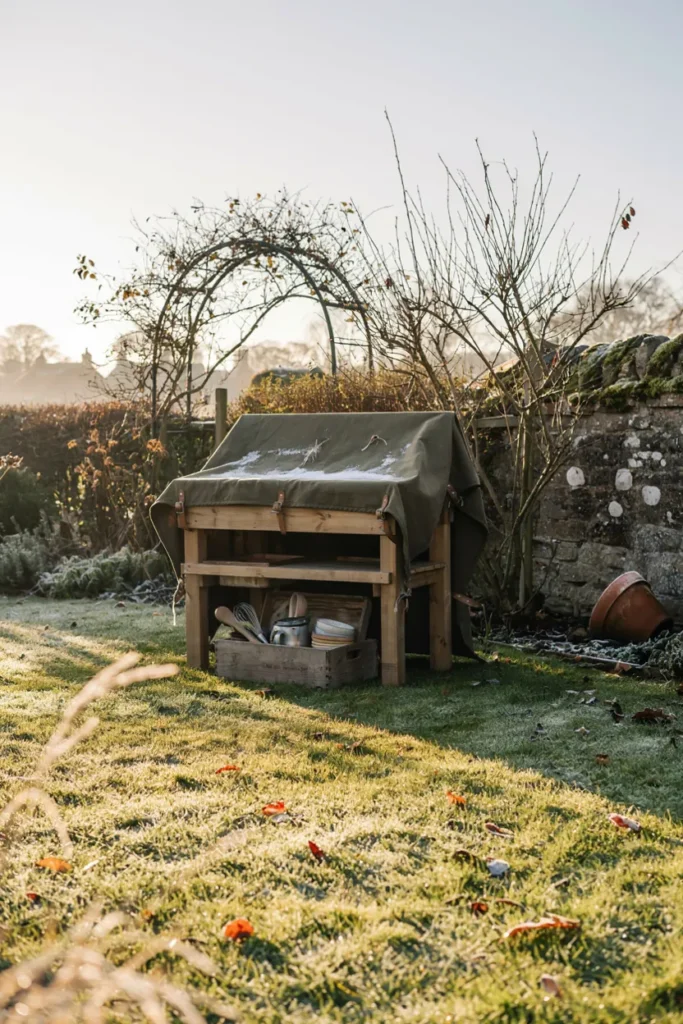
Restaurants close for the season; abandoned ones rot. The difference for a mud kitchen is one afternoon of care each fall — utensils crated, basins emptied, a fitted cover strapped on — and the reward is a build that lasts eight years instead of three. There’s a quiet parenting bonus, too: kids helping close their kitchen learn that loved things get maintained, a lesson no toy store sells.
Empty and invert basins, crate the tools into a lidded bin stored beneath, and oil wooden counters before covering. A fitted furniture cover or tarp with straps (never loose plastic that pools water) handles the weather. In mild climates, skip full closure and cover only the counter. Reopening day each spring becomes its own small ceremony — new jars, fresh chalk, ribbon optional.
Conclusion
Somewhere between the pallet sink and the potion bottles, a mud kitchen stops being a garden project and becomes a childhood landmark — the place where hours disappeared, recipes were invented, and the hose was never quite fast enough. That’s the real return on an afternoon of screws and salvage: not a structure, but a habit of outdoor, self-directed, gloriously grubby play. Whichever of these mud kitchen ideas fits your yard, your kids’ ages, and your tolerance for creative chaos, start simpler than you think — a counter, a basin, a spoon collection — and let the upgrades follow demand. The bakery sign and grill wing can wait for birthday weekends. Save your favorite builds to your Pinterest boards so the plan survives until the next free Saturday, then raid the garage and get building. The worm soup is going to be exceptional this year.