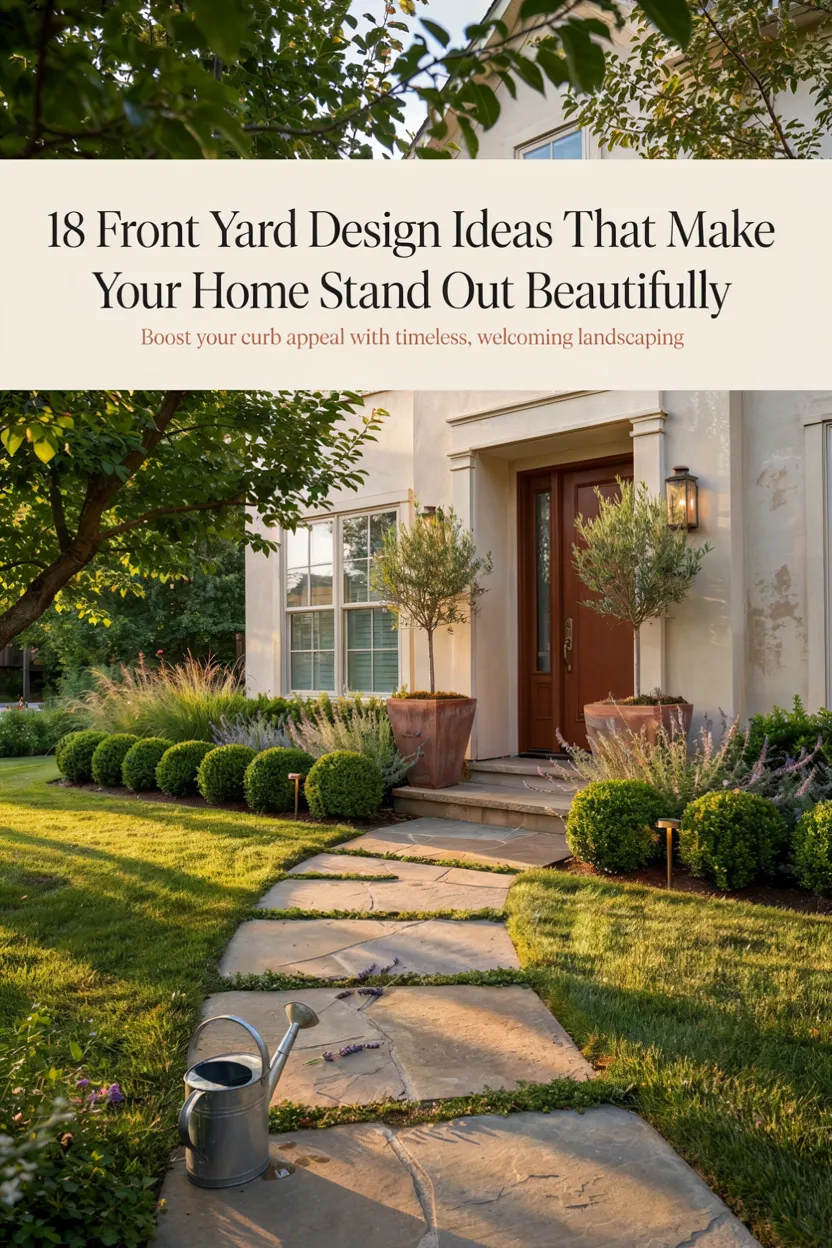
18 Front Yard Design Ideas That Make Your Home Stand Out Beautifully
Some houses stop you mid-scroll and mid-street, and it’s rarely the architecture doing the work — it’s the yard framing it. Front yard design is the difference between a house that sits on its lot and a home that seems composed for it: layers that build toward the door, a walkway that takes its time, one tree placed like punctuation. The encouraging part is that none of it demands a landscape architect’s invoice. These front yard design ideas break down eighteen moves that make homes stand out beautifully — layered beds and island plantings, curved paths, lighting that flatters after dark, and the color discipline that ties it all together. Each includes the proportions and plant logic that separate designed from decorated. Save the ideas that fit your frontage, then step across the street and look at your house the way strangers do. That view is the project. These are the moves I check for first whenever I pull up to style a home.
1. Foundation Beds in Three Deliberate Layers
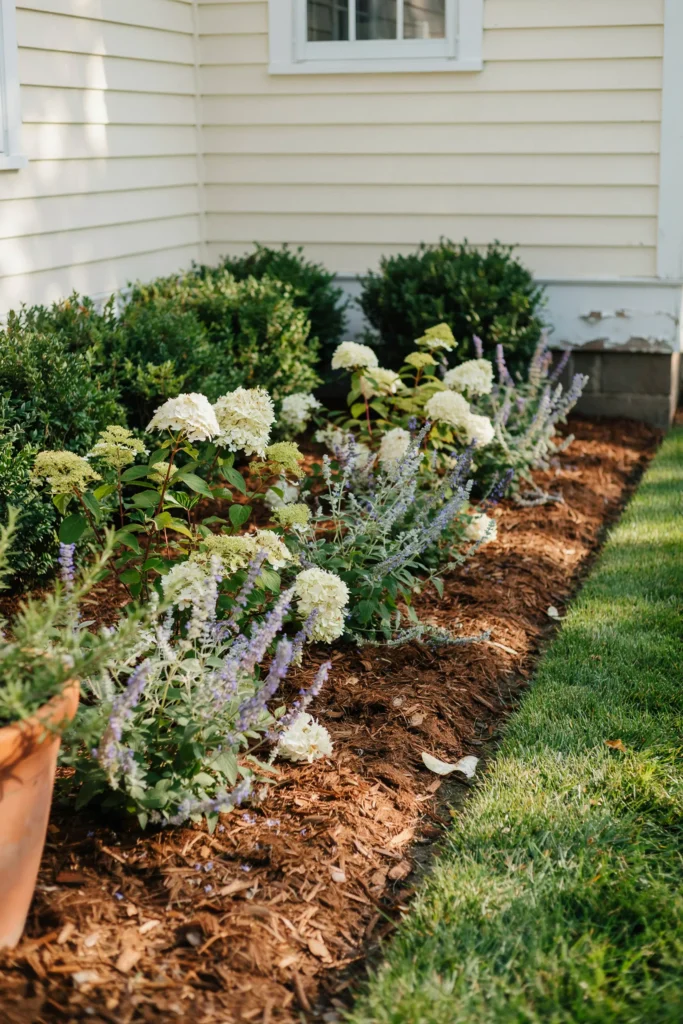
Most foundation plantings are one lonely row of shrubs standing at attention. Designers plant in three: evergreen structure at the back, a flowering middle band, and a low front ribbon spilling toward the lawn. The layers create depth that reads instantly professional — the bed looks generous, the house looks settled, and something is always performing regardless of season. It’s the single most transformative planting upgrade a front yard can get.
Make beds deeper than instinct suggests — six to eight feet minimum, because skinny beds can’t layer. Back row: boxwood, holly, or dwarf conifers. Middle: hydrangea, salvia, or daylilies in drifts. Front: catmint, low sedum, or liriope as a continuous edge. Repeat each plant in odd-numbered groups down the run, and cut a crisp spade edge where bed meets lawn — that line alone is half the polish.
2. Let the Walkway Take the Long Way
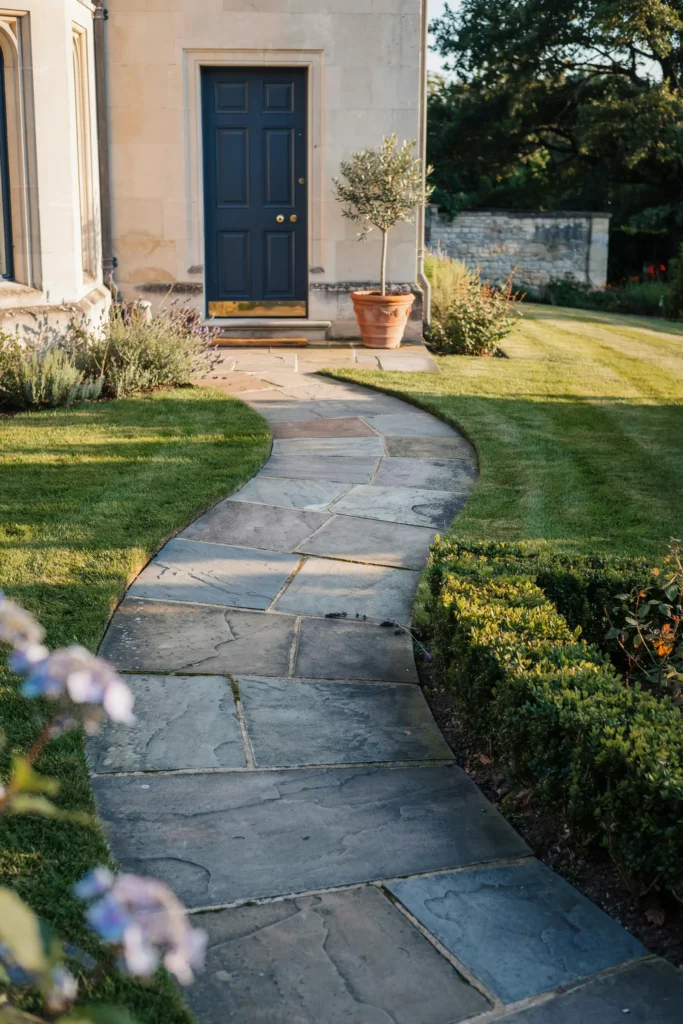
A straight concrete strip from sidewalk to stoop says one thing: get in, get out. A path that curves — even slightly — changes the entire experience of arrival, slowing the approach and letting the house reveal itself by degrees. Curves also create natural planting pockets at every bend, giving the lawn shape instead of leaving it a green void. Same distance, entirely different welcome.
Keep the curve honest: one lazy S, not a slalom, at least four feet wide so two people walk together. Large-format bluestone, oversized pavers, or broom-finished concrete sections all read current. Plant the outside of each bend generously so the curve looks like it exists for a reason. Replacing a straight walk is a weekend of demolition and the most permanent upgrade on this list.
3. One Specimen Tree, Perfectly Placed
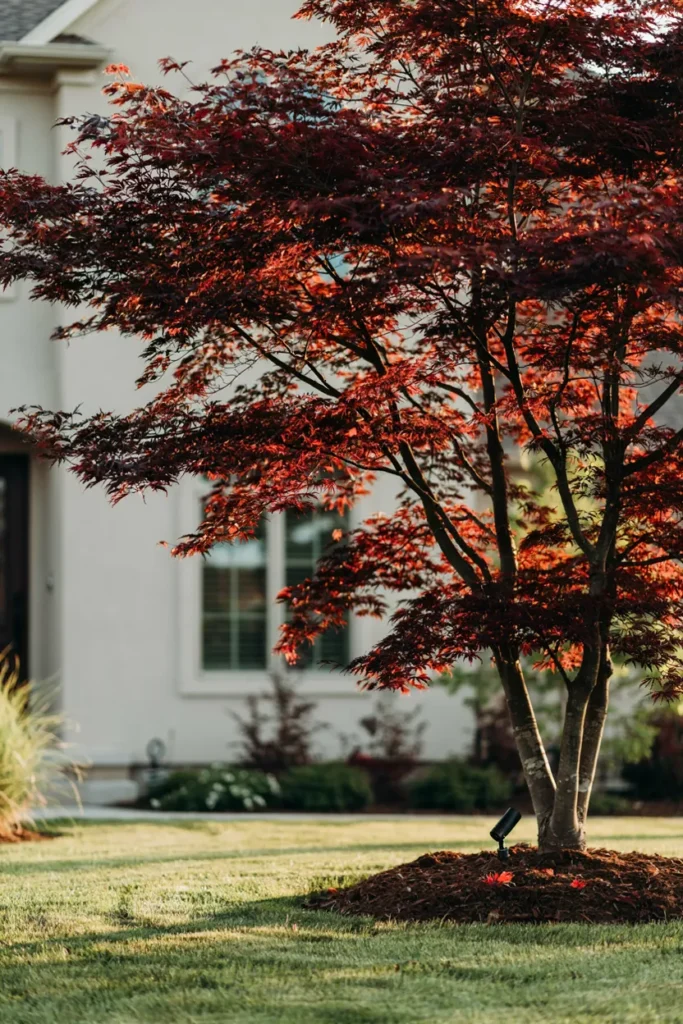
Every memorable front yard has a protagonist, and it’s usually a tree. One specimen — a multi-trunk Japanese maple, a spring-flowering dogwood, a white-barked birch clump — placed off-center in the lawn gives the whole composition a focal point that changes with every season. It draws the eye away from whatever the house lacks and toward what the yard has, which is exactly what focal points are for.
Position it a third of the way into the lawn, never dead center, and offset from the door so it frames rather than blocks. Size the mature spread to your yard — small lots want small trees with big character. Ring it with a clean mulch circle, resist underplanting for the first years, and bury one uplight at the trunk. Buy the largest caliper the budget allows; this is the yard’s single best investment.
4. Widen the Landing Into a Real Arrival
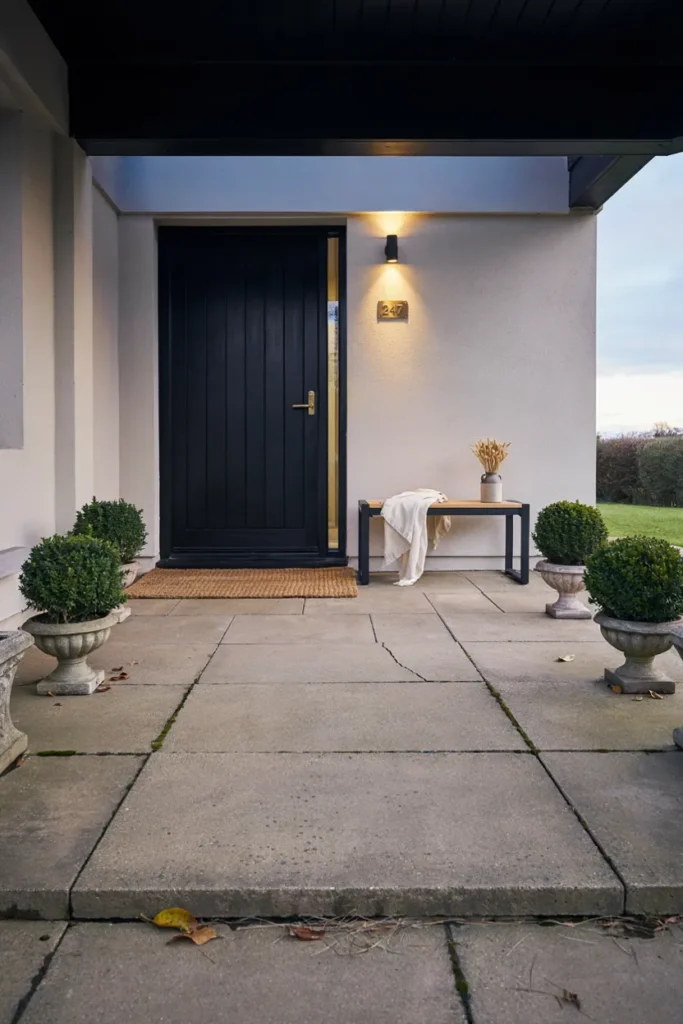
Most front doors land on a stingy square barely big enough for one person and a package. Widening that landing — doubling it, ideally — changes the psychology of the entry: guests gather comfortably, decor has room to breathe, and the door gains the presence of a real threshold. Builders shrink stoops to save concrete; expanding yours is quietly the most luxurious square footage you can add.
Extend with large-format pavers matched or deliberately contrasted to the walk, spanning at least twice the door’s width. Furnish like a small room: one bench or chair, one substantial planter per side, a doormat scaled up so it doesn’t float. Keep everything low so the door stays the tallest element. If steps are involved, widen those too — narrow stairs undo a generous landing.
5. Pick a Side: Formal Symmetry or Studied Asymmetry
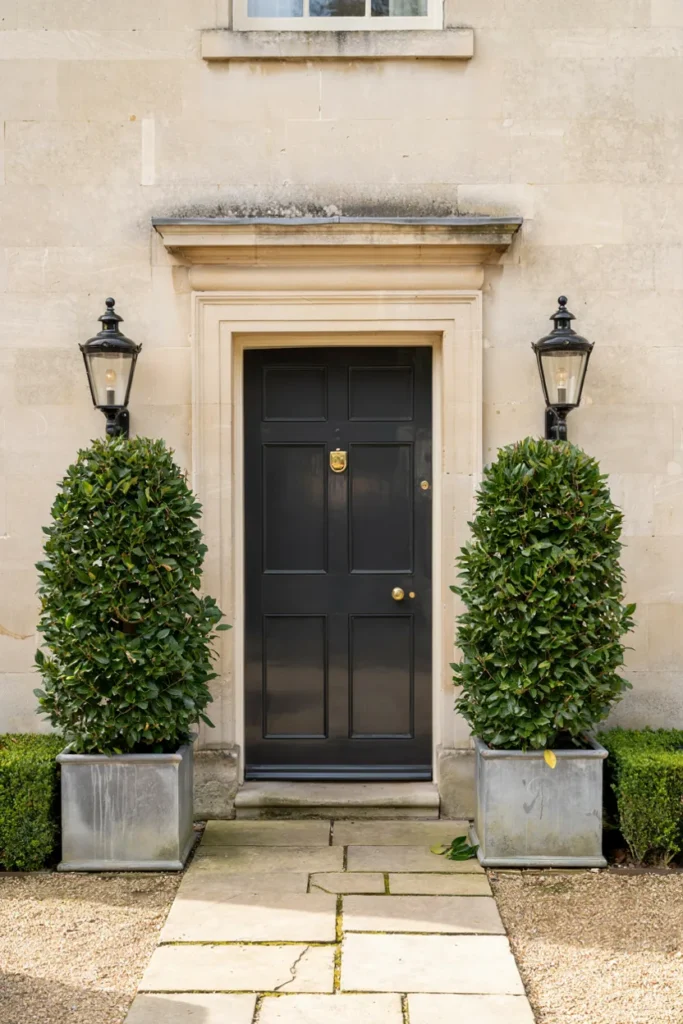
Great front yards commit to a geometry. Symmetry — matched planters, twin lanterns, a centered path — delivers instant formality and suits classic facades like a tailored suit. Asymmetry, done deliberately, reads modern and relaxed: one strong tree left, massed grasses right, weight balanced without mirroring. What kills curb appeal is the accidental middle — almost-matching, sort-of-centered, unmistakably unplanned.
Let the house vote: centered doors and balanced windows want symmetry; offset entries and modern lines want asymmetry. For formal schemes, buy true pairs at once — plants matched later never match. For asymmetric ones, balance visual weight rather than objects: a tall tree on one side equals a wide bed on the other. Then audit ruthlessly for accidental almost-pairs and break or complete them.
6. Mix the Walkway Materials
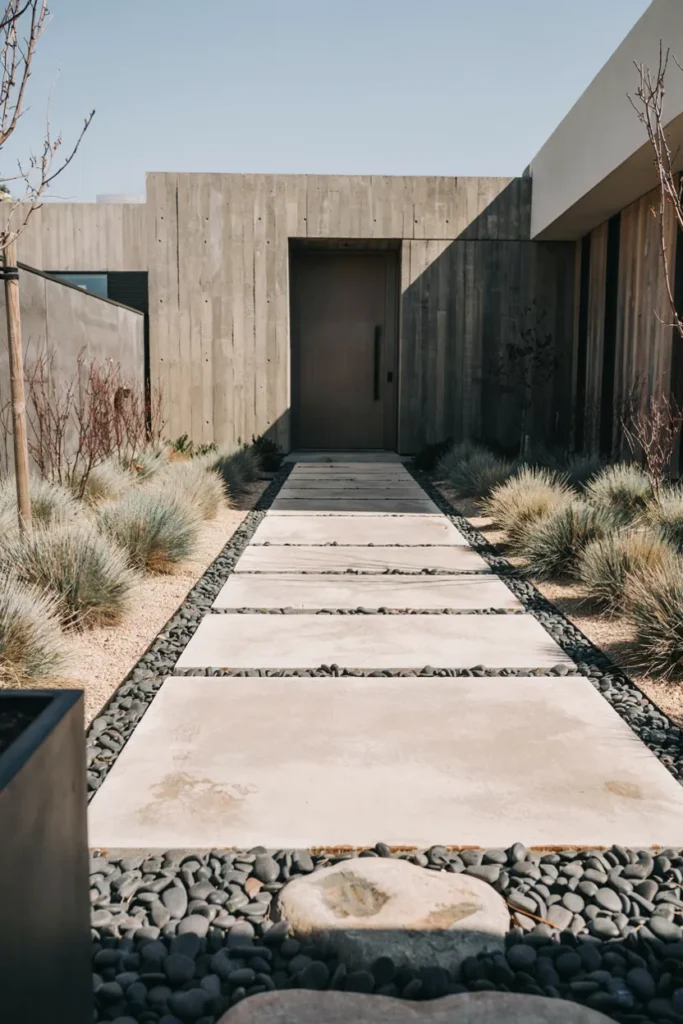
A walkway of one material is a path; two materials in rhythm is a design statement. Concrete slabs separated by ribbons of black pebble, bluestone broken by bands of thyme, brick edged in steel — the alternation creates a cadence underfoot and a custom look that single-material paths can’t touch. It’s the detail visitors photograph without knowing why it feels expensive.
Keep the recipe strict: one dominant material at eighty percent, one accent at twenty, repeating at perfectly even intervals. Set pebble or gravel bands in mortar or tight edging so they stay crisp, and keep everything dead level for safe walking. Two materials, maximum — three reads busy. This upgrade also retrofits: cut bands into an existing concrete walk and backfill with stone.
7. A Seating Vignette That Says Someone Lives Here
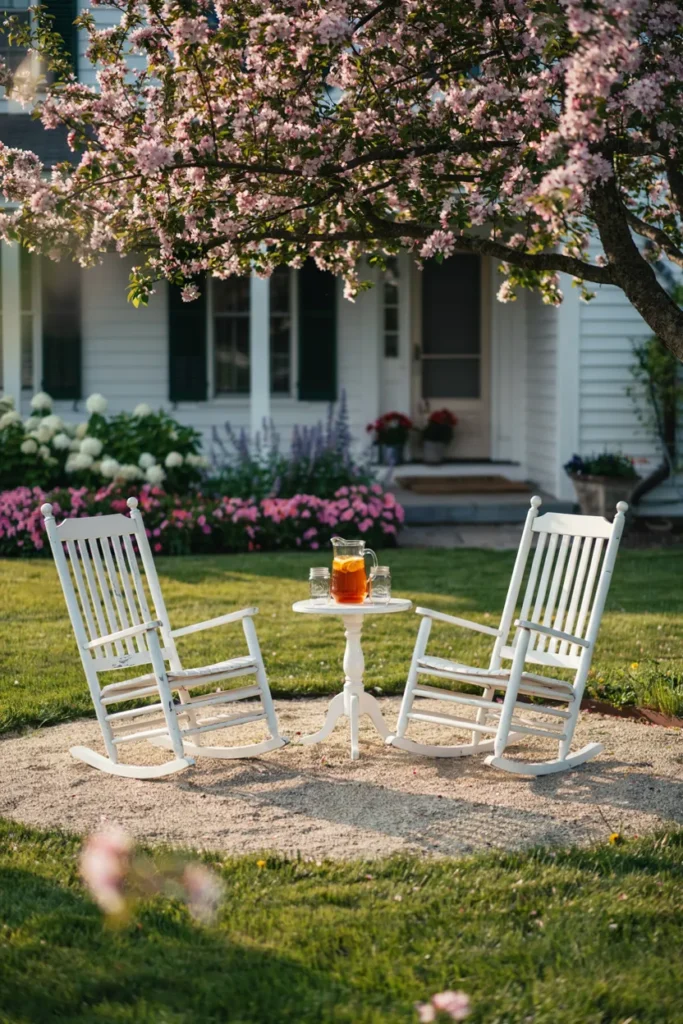
Backyards got all the furniture, and front yards got abandoned — which is exactly why a simple seating vignette out front stands out. Two chairs under a tree or angled on a gravel pad signal something buyers and neighbors respond to instinctively: people live here, and they like it. The vignette gets used more than expected too; front-yard sitting comes with sidewalk hellos that back patios never deliver.
Keep it deliberately small — two chairs, one table, a defined pad of gravel or pavers so it reads as a room, not stray furniture. Site it under the specimen tree or beside the porch where there’s partial shade and a view of street life. Durable rockers or Adirondacks in one crisp color photograph best. Add a pot of something fragrant and let the neighborhood do the rest.
8. Anchor the Corner Lot
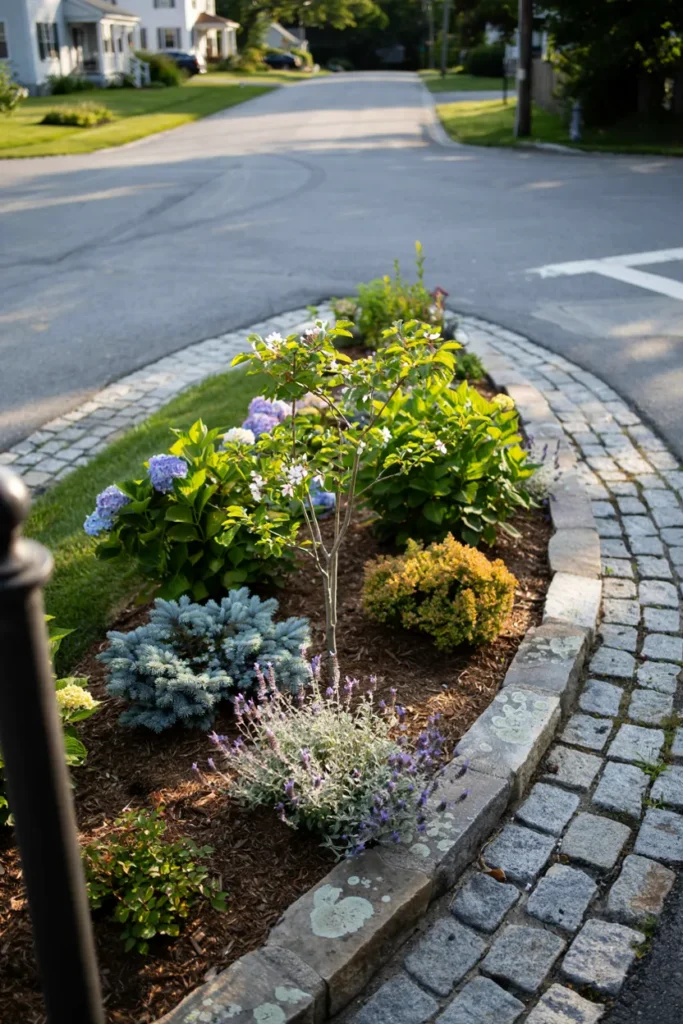
Corner lots get judged from two streets and usually plant for neither — just lawn bleeding to the intersection. A generous anchor bed at the corner itself flips the exposure into advantage: a small tree, layered shrubs, and perennials wrapped in a curved edge that greets both directions of traffic. It’s the difference between a lot that leaks away at the corner and one that plants a flag there.
Sweep the bed in a broad arc facing the intersection, sized bigger than feels safe — corner beds under ten feet vanish at street speed. Layer tall to low from the inside out so sightlines stay open for drivers, keeping everything under three feet near the actual corner. One ornamental tree, three to five shrubs, perennial fill. Mirror a smaller echo bed at the driveway for cohesion.
9. Float an Island Bed in the Lawn
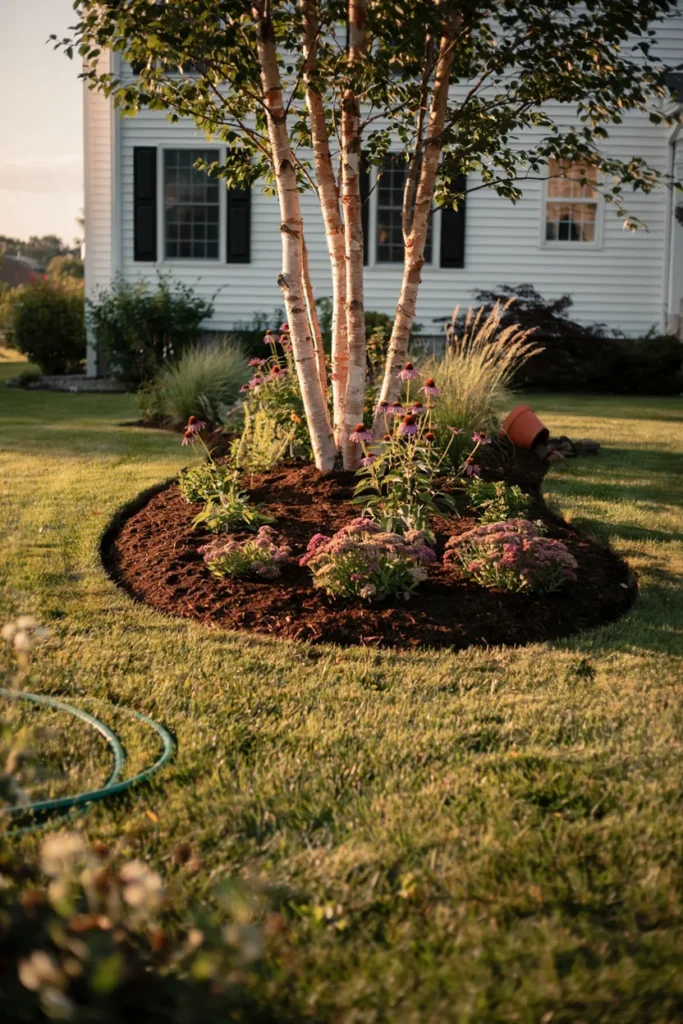
A flat sheet of lawn is a missed opportunity wearing green. An island bed — kidney-shaped, floating free of the foundation — breaks the flatness with a hill of life: tree at one end, grasses and perennials flowing to a low edge. It adds the dimension flat yards crave, screens selectively without fencing, and gives the lawn a reason to curve around something. Parks use this trick every hundred feet.
Scale matters: the bed should span at least a third of the lawn’s width or it reads as a traffic island. Kidney and teardrop shapes mow around gracefully; sharp corners don’t. Build tall-to-low from center out — birch or serviceberry, then grasses and coneflowers, then a groundcover rim. Position it to frame the house view from the street, never to block the door.
10. Rotate Seasonal Color at the Entry Only
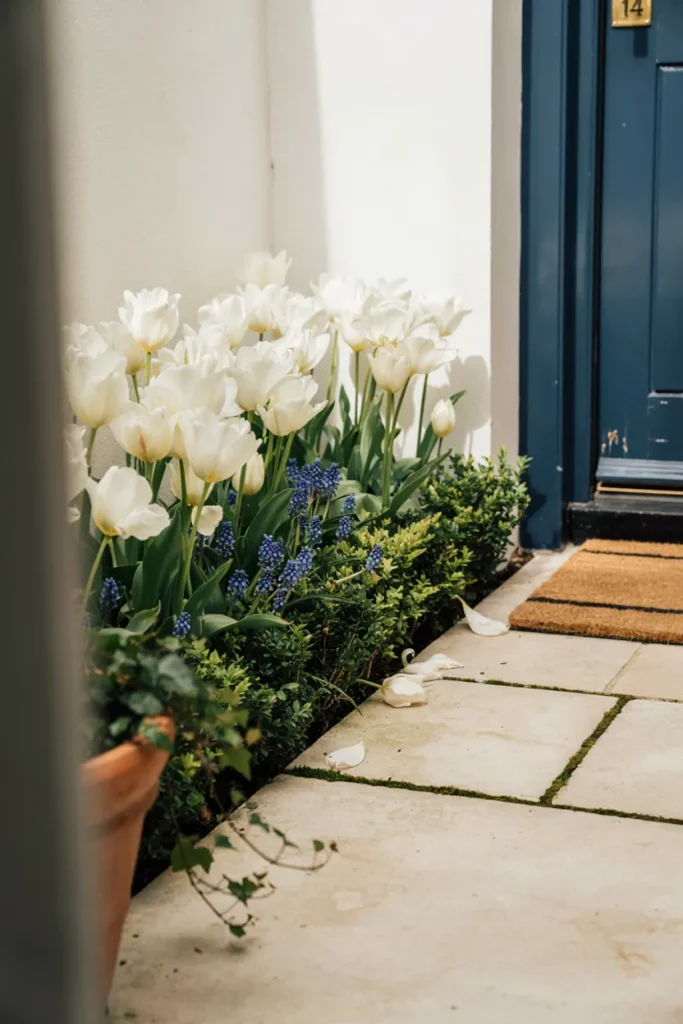
Trying to keep a whole yard in bloom year-round is a losing war. Designers concentrate instead: one small bed at the entry, replanted hard each season — tulip masses in spring, white impatiens or salvia through summer, mums and kale for fall, cut evergreens in winter. Fifteen square feet of full commitment outperforms a thousand of scattered effort, because it lives exactly where every visitor and every photo looks.
Frame the rotation bed in permanent boxwood or steel edging so structure survives changeover weeks. Plant each season in one or two colors only, massed — twenty tulips of one white beat fifty mixed. Budget roughly the cost of a dinner out per season. Bulbs go in each fall; everything else is a garden-center flat and an hour. The entry earns its keep all year.
11. A Modern Slat Fence With a Gravel Reveal
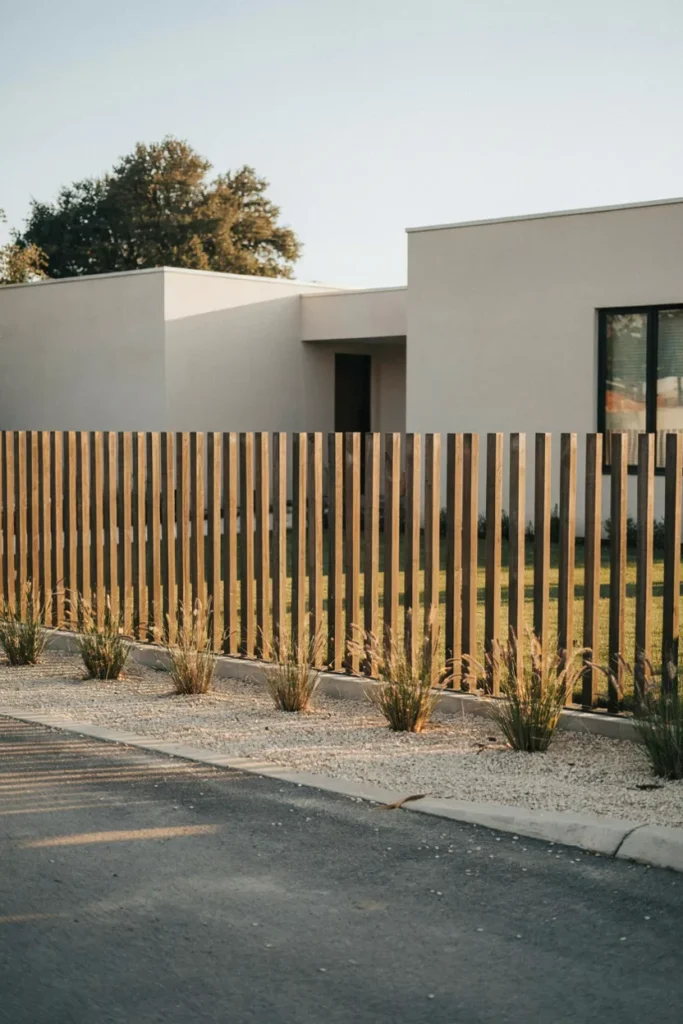
Nothing modernizes a frontage faster than horizontal lines. A low slat fence — cedar or black aluminum, three feet or so — draws a warm, disciplined edge along the property, and a gravel strip planted with evenly spaced grasses on the street side finishes it like architecture. The combination defines the yard without hiding the house, adding the tailored border modern facades are practically begging for.
Keep the fence low and open-gapped so it frames rather than walls; check local front-yard fence limits first. Run a two-foot gravel band on the public side, one grass or boxwood ball every four feet like a metronome. Stain the cedar or let it silver uniformly — half-weathered reads neglected. Gate at the walkway with matching slats, hardware hidden. Restraint carries the whole look.
12. A Hydrangea Hedge Below the Porch Line
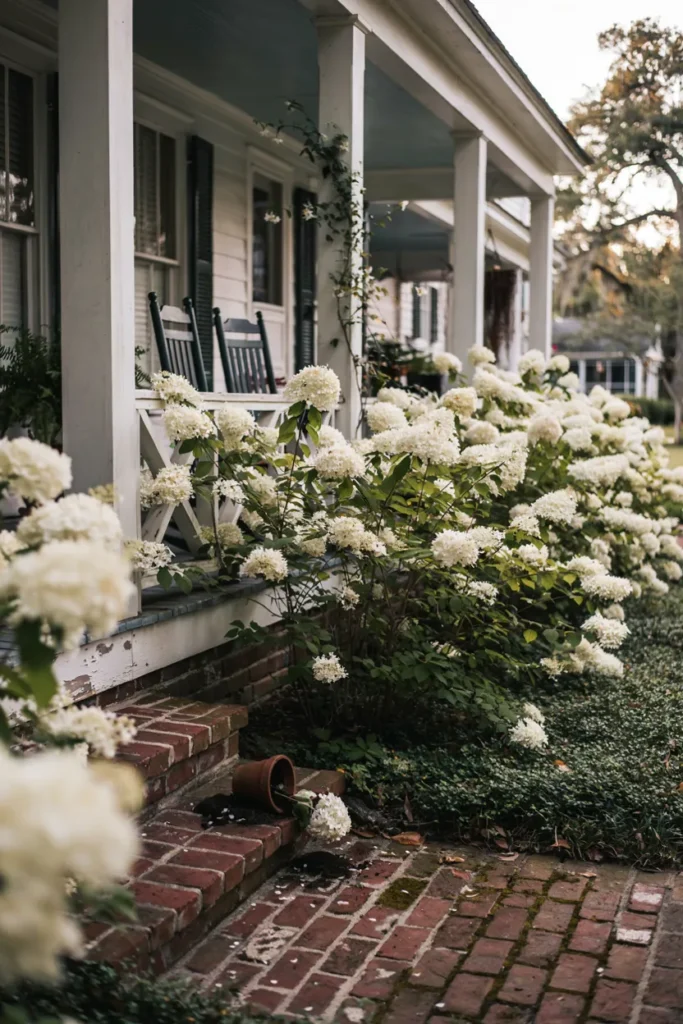
Some plants carry entire regions on their shoulders; the porch-front hydrangea hedge is one of them. A run of white or blue mopheads billowing just below the railing gives a house instant softness and generosity — the floral equivalent of a wraparound smile. From June to frost the hedge does the decorating, and even its dried winter heads hold a faded charm worth leaving standing.
Panicle types like ‘Limelight’ and ‘Bobo’ take more sun and bloom reliably everywhere; macrophyllas want gentler light and give the blues. Plant three feet apart, three feet off the porch for airflow, in soil that never fully dries. Size the variety to finish below the rail so blooms trim the porch rather than swallow it. One pruning lesson per type — learn yours and the hedge runs decades.
13. Light the Yard in Three Layers
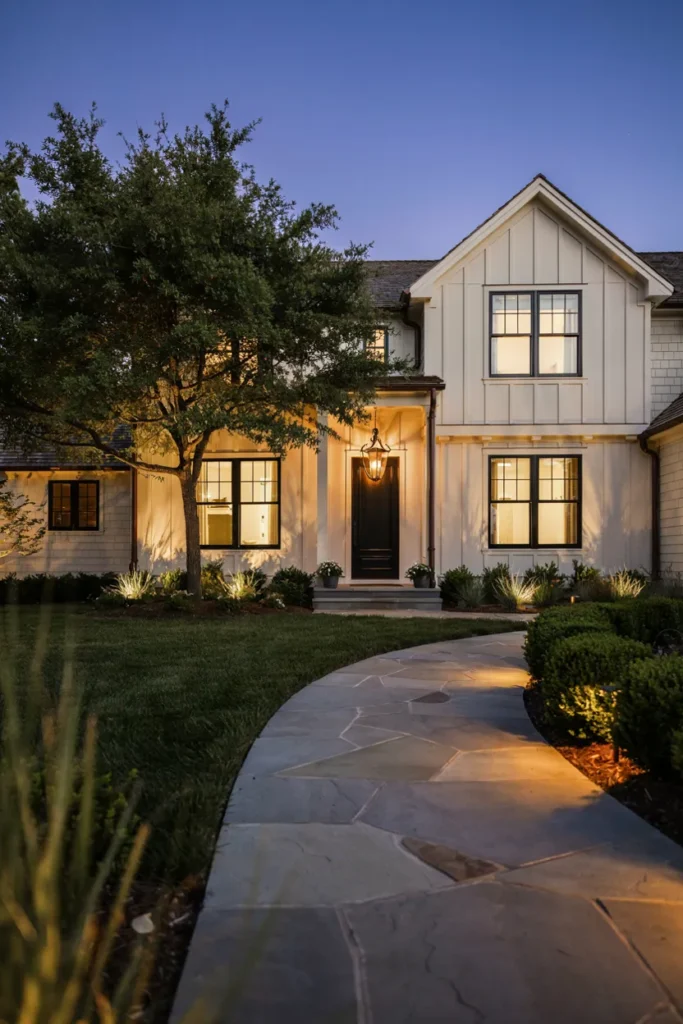
Half of every day is dark, and most front yards simply vanish for it. Layered landscape lighting keeps the design working nights: path lights tracing the walk, an uplight making the specimen tree glow like sculpture, a soft wash across the facade’s best texture. Three layers, all warm, and the house becomes the one on the street people slow down for after dinner.
Follow the designer ratio — light the path for safety, the tree for drama, the facade for depth — and stop there; over-lit yards feel like used-car lots. Warm white only, 2700K, everything on one dusk timer or photocell. Low-voltage kits install in an afternoon with no electrician, and solar has finally gotten good enough for paths. Aim every fixture so the bulb itself stays hidden.
14. Build a Berm Where the Yard Is Flat
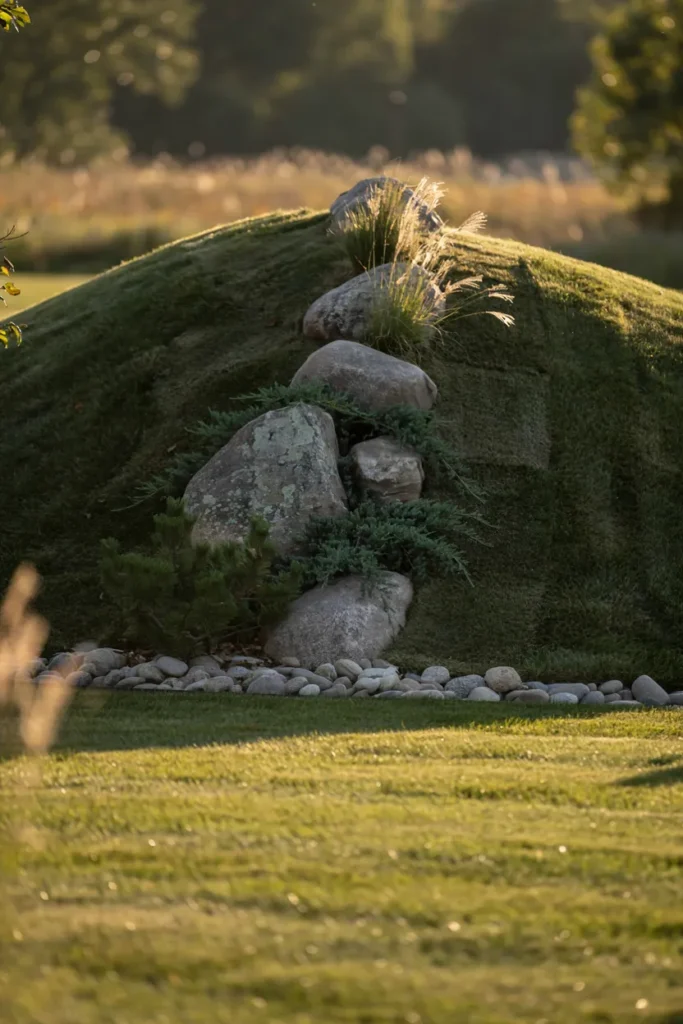
Flat lots are honest but boring — every plant stands at the same altitude, every view reads in one line. A berm fixes the topography itself: a gentle mound of soil, two or three boulders seated into its slope, planting that climbs and spills. Suddenly the yard has a landform, shadows move across it all day, and the flatness that made the lot forgettable becomes its before photo.
Shape the berm long and low — three times wider than tall, cresting under thirty inches — so it reads as landform, not burial. Site it off-center like the island bed, often around the specimen tree. Bury boulders a third deep, group them in odd numbers, and plant conifers, grasses, and spillers into the slope. A few truckloads of soil and a weekend build what the glacier forgot.
15. Train Something Up the Facade
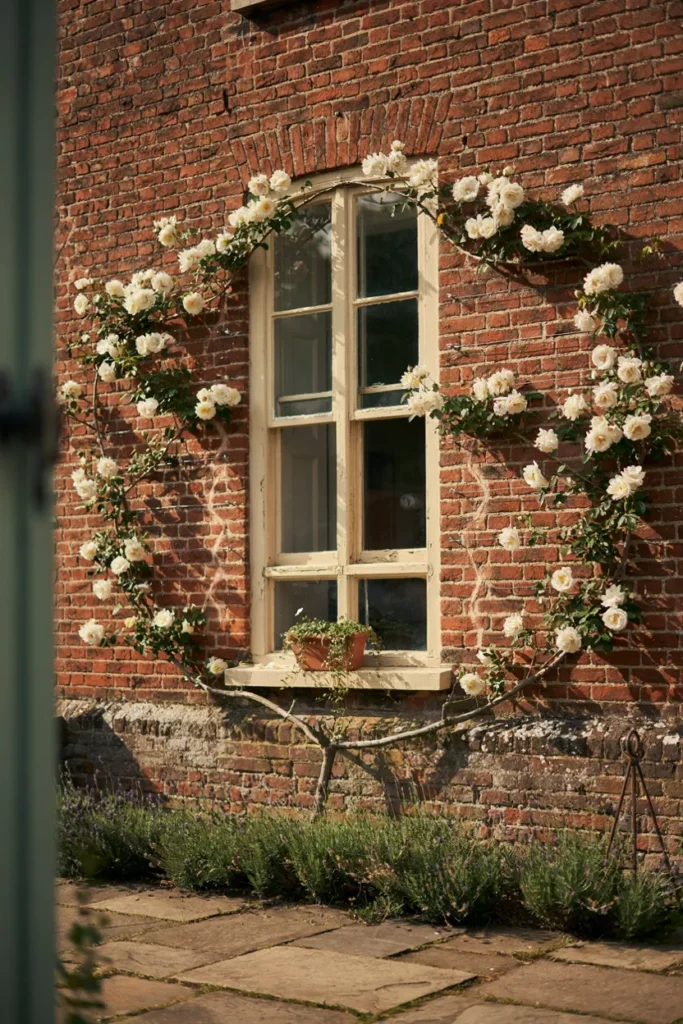
Walls are the biggest unplanted surface a front yard owns. A climbing rose arching around a window, a wisteria on stout wires above the garage, an espaliered pear flat against the brick — trained plants give a facade the established romance that normally takes generations. One well-placed climber can do more for a plain front wall than any renovation short of new architecture.
Install the support first: stainless wires on standoff eyebolts, or a sturdy trellis held four inches off the wall for airflow. Match vigor to structure — roses and clematis for wires, wisteria only on serious hardware, self-clinging ivy never on wood siding. Fan and tie canes each season; horizontal training multiplies blooms. Three years of patience buys thirty of storybook.
16. A Rain Chain and Basin Worth Watching
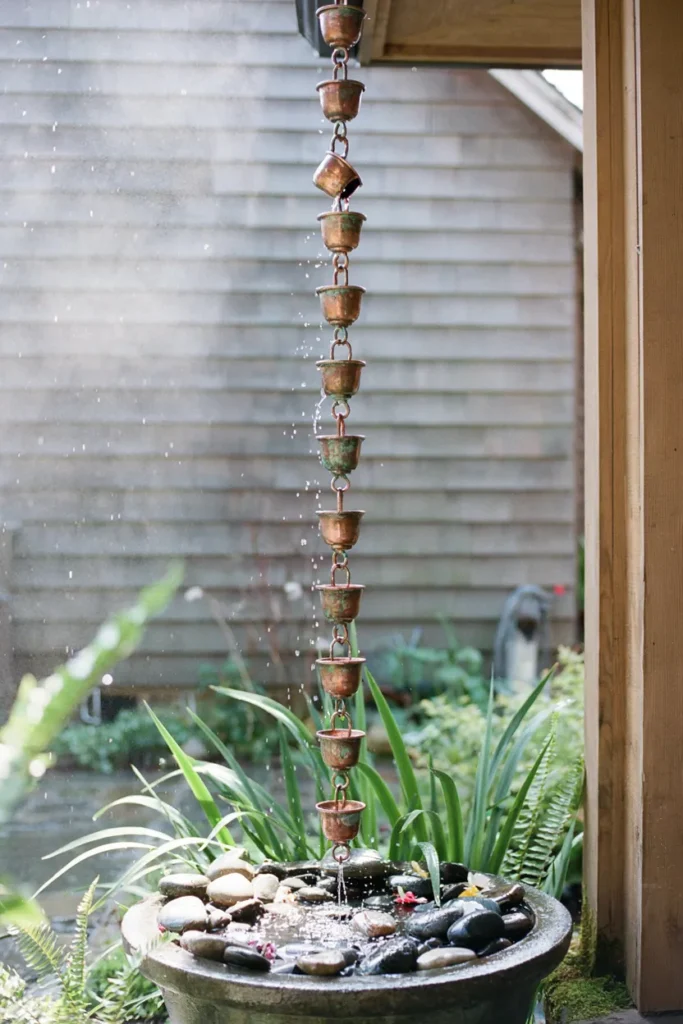
Downspouts are the plumbing nobody hides well. A rain chain replaces one with choreography: copper cups spilling rain hand-to-hand down into a basin of river stones, turning every shower into a small water feature at the corner of the porch. It’s a detail guests notice in the first ten seconds — proof that even the drainage was designed on purpose.
Hang the chain from the existing gutter outlet on the porch’s most visible corner, weighted or anchored into a stone-filled basin that drains to a planted pocket of ferns and iris. Copper ages to the best patina; anodized aluminum keeps its color in harsh sun. Chains handle moderate roof sections — keep the far side’s conventional downspout for storms. Beauty and function split the roof between them.
17. Plant the Strip Nobody Claims
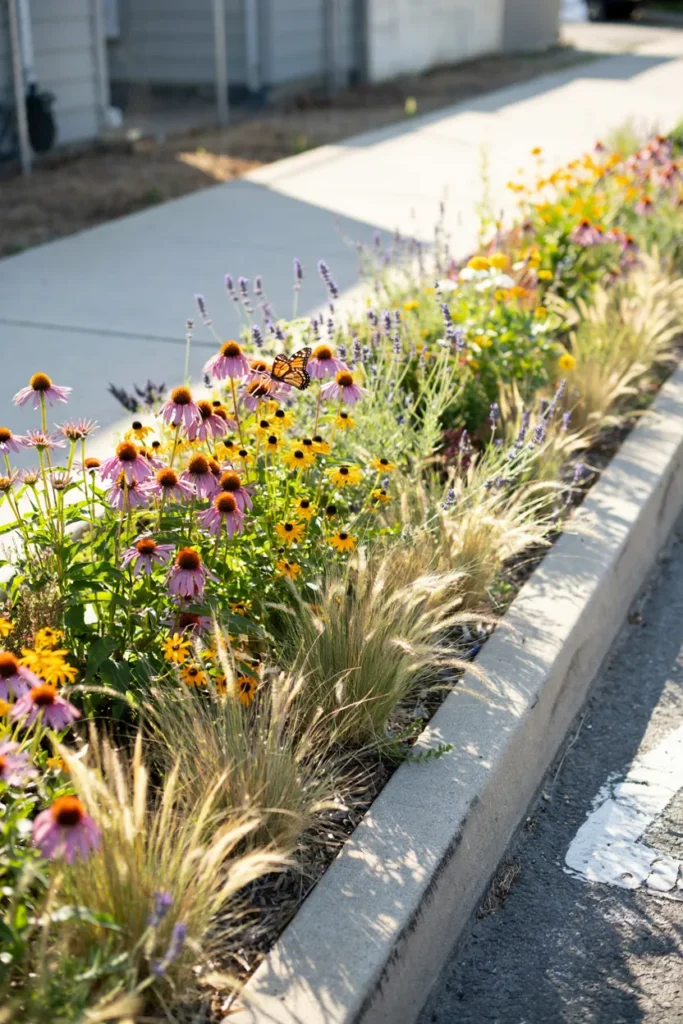
The strip between sidewalk and street — too dry for lawn, too public to love — is the yard’s forgotten frontier. Planted as a pocket prairie of tough natives, it becomes the most generous gesture on the block: flowers at ankle height for every passerby, pollinators working the coneflowers, and a home whose curb appeal literally starts at the curb. Neglect converted to signature.
Check city rules first — most allow plantings under thirty inches with clear sightlines. Choose drought-proof natives that survive salt and stray feet: coneflower, black-eyed susan, prairie dropseed, low catmint. Plant densely so weeds lose, mulch with gravel, and water only the first summer. Keep edges tidy against both concrete lines; crisp borders are what tell the neighbors it’s a garden, not surrender.
18. Run One Color Story Through Everything
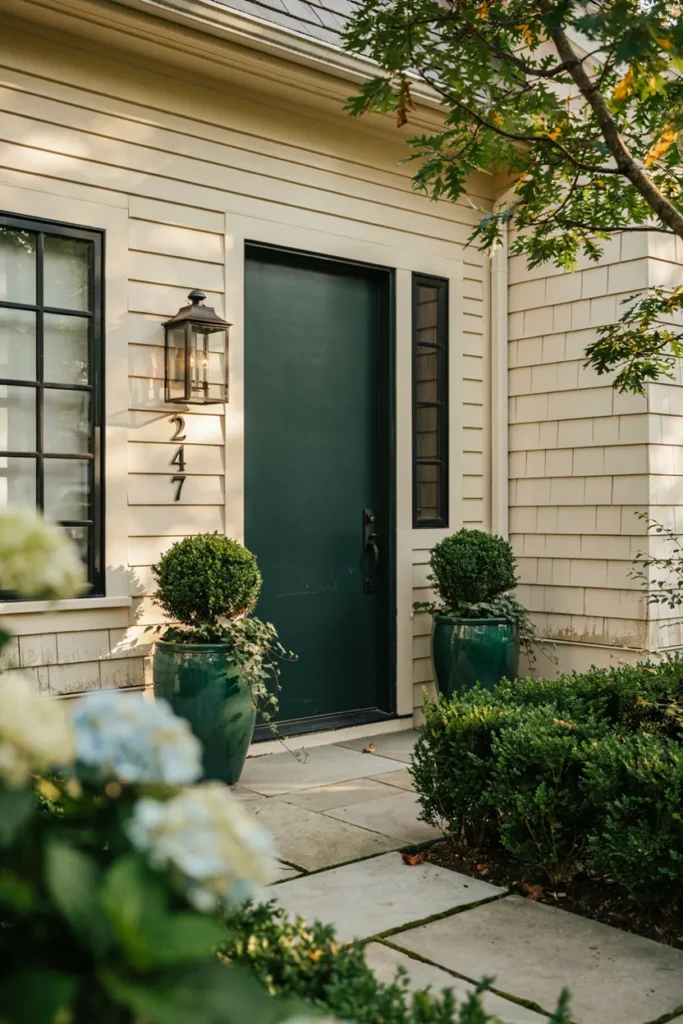
Strip away the technique, and designed front yards share one secret: everything agrees. The door color reappears in the planters, the window-frame black echoes in lanterns and numbers, even the plant palette leans one direction. That repetition — two colors plus green, carried through every choice — is what makes a yard read curated at a glance, before any single feature registers.
Audit what’s fixed (brick, roof, siding) and choose one accent plus one neutral that flatter it. Then repeat with discipline: accent on the door, pots, and cushions; neutral on fence, numbers, and fixtures. Photograph the yard in grayscale to check value contrast — good schemes still read. When every future purchase passes through the two-color filter, the yard stays designed forever.
Conclusion
Standing out beautifully was never about doing the most — it’s about the yard agreeing with itself. A path that curves for a reason, layers that build toward the door, one tree with a spotlight, one color story told everywhere: each choice multiplies the others, which is why homes with half the budget routinely outshine the McMansion down the street. Treat these front yard design ideas as a menu and start where your lot is weakest — the flat lawn wants an island or a berm, the stingy stoop wants widening, the vanishing corner wants an anchor. Two or three projects a season is the sustainable pace, and the compounding is real. Save your favorites to your Pinterest boards so the whole vision stays in one place while the seasons and budgets catch up. Then take that walk across the street one more time — before long, you’ll be the reason other people slow down. Ready to go further than trimming the lawn? These grass-free front yard ideas reimagine it entirely.